GLADIATOR II (2024) review

written by: David Scarpa
produced by: Ridley Scott, Michael Pruss, Douglas Wick, Lucy Fisher & David Franzoni
directed by: Ridley Scott
rated: R (for strong bloody violence)
runtime: 148 min.
release date: November 22, 2024
24 years ago, we lived in a world where “Gladiator” beat out “Crouching Tiger, Hidden Dragon” for Best Picture at the Oscars. It had been quite a while since any Hollywood studio brought a Roman Empire epic to the big screen, and director Ridley Scott aimed to revitalize the genre. It became a huge hit and earned five Oscars, including a Best Actor award for star Russell Crowe. Indeed, audiences were entertained! A month after its release, there were talks of either a prequel or sequel, and rumors continued over the years until Paramount took over the rights from Dreamworks around 2018, and now we have “Gladiator II”.
It’s easy to wonder who would care about a sequel to “Gladiator,” but perhaps the more pertinent question is: Who remembers the first one? Oh, sure, it won awards, was viewed multiple times, and became highly quotable, but I’d wager many moviegoers have forgotten it.
Case in point: I’ve spoken with two different friends within the past couple of weeks, each time mentioning what movies are coming out. When “Gladiator II” came up, both had the same question: “Is Russell Crowe going to be in it?”
Such a question elicited a double-take from me. Both of them had forgotten that Crowe’s Maximus Decimus Meridius had (SPOILER ALERT!) died at the end of “Gladiator,” and because they both asked this, I wondered if even I remembered the ending correctly. There was so much talk of the afterlife in the first movie that maybe Crowe would show up in a sequel on that ethereal plane, where your gladiator bod transitions into a Falstaff physique.
So, despite the movie’s success and popularity, not everyone recalls how “Gladiator” played out. But maybe what we watched in 2000 echoes only vaguely in eternity. That could be an advantage for Scott and company, considering some viewers could use a refresher while others will likely experience his return to sword and sandal action for the first time.
“Gladiator II” is a movie that resembles a remake more than it does a sequel, although it could be considered both. Understandably, it’s more concerned with “gladiating” than providing anything different or new. It may continue the stories of some existing characters, but it also resembles the outline of “Gladiator.” The main difference here is that Scott has a bigger budget and improved CGI to play with, which allows the auteur to fill the coliseum with rabid baboons, saddled rhinos, and swimming sharks – not all at once, mind you, but that would be amazing!
Screenwriter David Scarpa reunites with Scott after they worked together on “All the Money in the World” and last year’s “Napoleon.” He essentially takes a storyline that is very similar to the first movie, weaving revenge, betrayal, and deceit as thematic threads.

The sequel takes place sixteen years after Maximus drifted off into the wheat fields and revolves around Lucius Verus Aurelius (Paul Mescal), the son of Lucilla (Connie Nielson, reprising her role), the daughter of the late Marcus Aurelius. She snuck him out of Rome at a young age and sent him off to northern Africa to ensure he would be far away from her brother, Emperor Commodus, and his counsel. Now an adult, Lucius goes by the alias “Hanno” and as the film opens, he and his wife, Arishat (Yuval Gonen), can be seen defending their homeland, the province of Numidia, from Roman conquerors, led by General Acacius (an underutilized Pedro Pascal). When Arishat is killed in battle, Lucius vows vengeance, focusing all his pain on Acacius as he is sold into slavery and shipped off to Rome.
Lucius catches the attention of stable master Macrinus (Denzel Washington) after savagely besting a feral baboon in a brutal sales display of potential gladiators. Attracted to the young man’s rage, former slave and gladiator Macrinus purchases Lucius to groom him to win over spectators in the Roman Colosseum. Macrinus is a known power player in the Senate, supplying goods and weapons to the Roman armies to rise to a position of political power. Macrinus has the ear of the council primarily because corrupt Senator Thraex (Tim McInnnery) owes him a load of money and uses this to influence twin brother Emperors, Geta (Joseph Quinn) and Caracalla (Fred Hechinger), both of whom are plotting to conquer Persia and India while demanding order in Rome.
His focus on killing Acacius changes once Lucius learns he’s married to Lucilla, even more so when he realizes that she’s his mother. Lucilla is also taken aback when she discovers the gladiator she’s watching in the coliseum is the son she sent away. While they come to terms with their current status, Lucilla conspires with certain members of the Senate, such as Senator Gracchus (Derek Jabobi, also reprising his role), to overthrow the Emperors’ grasp and restore the Roman Republic. Lucius is on board with the coup, secretly enlisting support from Acacius’ army. But they must contend with a manipulative Macrinus, scheming his way to a position where he can watch Rome fall.
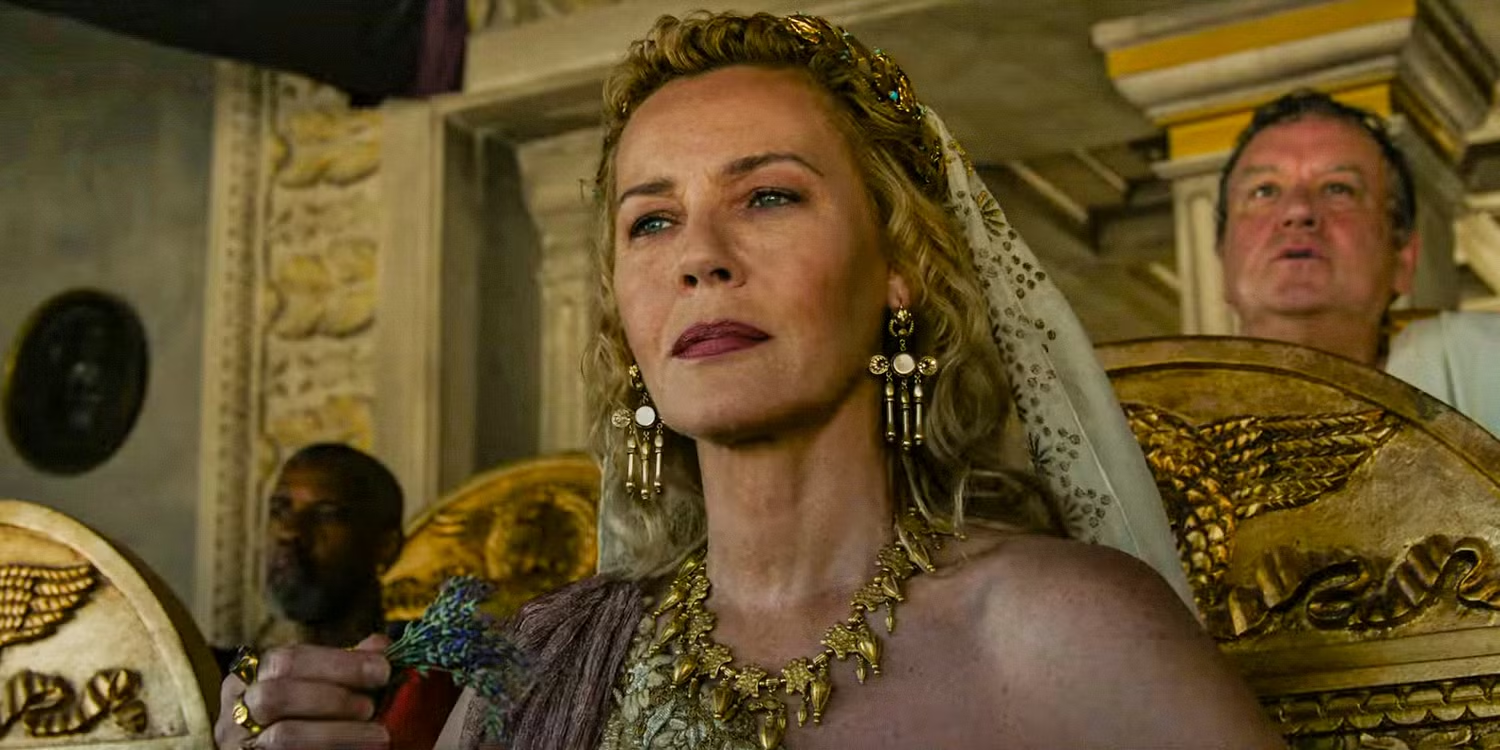
Without a doubt, the audience will be comparing “Gladiator II” to “Gladiator” while watching the sequel, which is something Scott wants, considering how many references and callbacks there are here. The movie starts and ends with conjured images of the first movie. The opening credits consist of painterly animated images that recap the first movie’s events. It’s a way to remind viewers or catch them up to speed, but it’s also an indicator that this sequel won’t be able to stand alone, with Scott constantly showing how in love he is with his Oscar-winning movie. There are also sepia-washed flashback clips (editing floor footage from “Gladiator”) showing Spencer Treat Clark as young Lucius being scuttled off to Africa or of Crowe, lest we forget the nonstop mentions of Maximus.
There are other ways in which Scarpa uses the screenplay from “Gladiator” as a template for this sequel, essentially following the same beats of the last story. Just as that movie opened with an epic battle, Scarpa and Scott kick off “Gladiator II” with the Roman invasion of North Africa. It’s a major battle that shows how Scott knows his way around a battlefield, reuniting here with “Gladiator” cinematographer John Mathieson to deliver the kind of combat sequences we expect from the director. That being said, the action in the coliseum isn’t as visceral and riveting as the first movie; everything is just bigger, which doesn’t necessarily mean better.

Whether or not it’s accurate history that baboons and sharks were used in coliseum games isn’t so much an issue as it makes logical sense in “Gladiator II.” Early on, Lucius survives an encounter with one of those rabid baboons by biting into the primate’s arm. Editors Sam Restivo and Claire Simpson (another frequent Scott collaborator) quickly cut to the aftermath without indicating how anyone else (humans or baboons) faired in the fight. While the sequence involving ships fighting in a flooded arena with circling sharks seems unbelievable (and borderline ridiculous), apparently, this actually happened. Well, at least the water part. If we’re really going there, I want a scene that shows the intricacies of relocating sharks into an arena. Were there canals? If so, how were the sharks corralled from the sea? Something so out of left field needs an explanation, even if it’s ridiculous. Make it make sense, even if it is a broad exaggeration of history.
As for the new characters in “Gladiator II,” the main difference is that there are three antagonists: the two Emperors and Washington’s Macrinus. The co-emperors are pretty one-dimensional and are missing the layers that Joaquin Phoenix utilized. In his role as Geta, Quinn has stated in interviews that he was influenced by MTV’s Beavis and Butthead of all things) as well as John Lydon of The Sex Pistols. Hechinger was on the same wavelength, finding inspiration from Sid Vicious, although his Caracalla is a bit crazier and has a pet monkey. With both of these characters overseeing (if you can call it that) the empire, it would’ve been more absorbing to delve into who they are. Still, they appear too vapid for meaningful depictions or motivations besides vanity and greed.
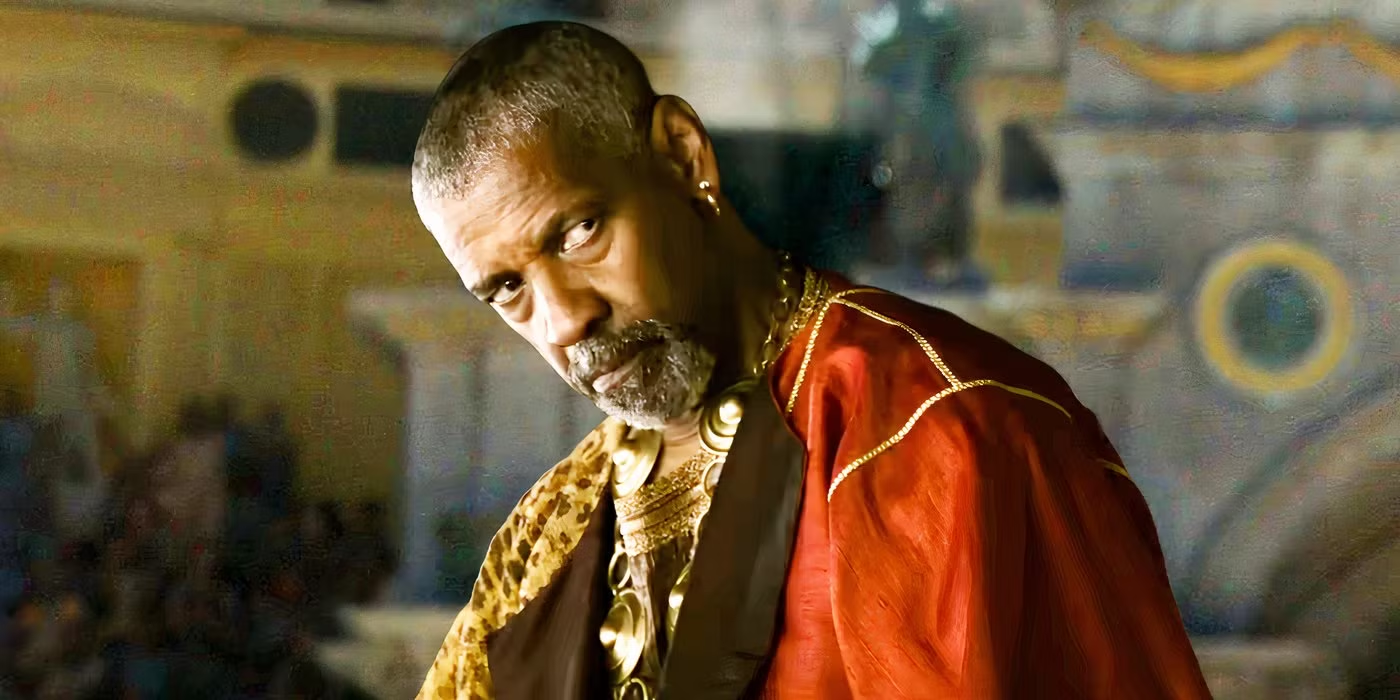
The third antagonist, played by Washington, is perhaps the most intriguing character of the entire sequel, even though it’s unclear if we’re supposed to be impressed by his actions or laughing at his behavior. Seeing the acting legend Denzeling his way throughout the movie is fun. While he certainly doesn’t disappear into the role, Washington keeps viewers guessing by throwing almost everything into it. Sometimes, he’s mugging the camera or comes across as cartoonish. In contrast, at other times, he can be seen as a cunning opportunist who uses his influence, intellect, and flamboyance to get what he wants. One thing is certain: Marcinus isn’t an entirely predictable character, and that’s refreshing.
The film aims to establish Lucius as a tortured man of revenge. Still, Scott is primarily interested in creating chaos, finding a critical death emotionally weightless, and Lucius’s surrender to the Romans is oddly casual, which seems to go against the idea of the character’s fury. Mescal isn’t as magnetic a presence as Crowe, and that’s understandable. Still, there are moments here where the protagonist is giving more moments of inspiring leadership outside the arena than Maximus ever had. There could’ve been more scenes between Mescal and Pascal to stoke the intended tension between the two, but maybe that’s another thing aspect of the movie that was cut.
When it comes to period pieces, Scott excels at spectacle, often relishing ambitious visuals and epic storytelling over prioritizing compelling characterization. He’s also known for stretching out his big-budget movies to quite a lengthy runtime with almost all of them inevitably dropping an “extended cut” or “director’s cut” after its theatrical run. The problem is if viewers aren’t impressed or entertained by a movie that runs almost three hours, there’s no interest in one that’s peaking at four or five hours.
There may not be much to offer in terms of freshness in “Gladiator II” since Scott is fine with staying mostly aligned with his previous offering. It’s a period piece void of full immersion, one that provides bursts of applause-worthy entertainment.

RATING: **1/2


