WOLF MAN (2025) review

written by: Leigh Whannell and Corbett Tuck
produced by: Jason Blum
directed by: Leigh Whannell
rated: R (for bloody violent content, grisly images and some language)
runtime: 103 min.
U.S. release date: January 17, 2025
I used to not care so much about the runtime of a movie, but towards the end of last year, it seemed like all the movies I was trying to catch up with were over two hours, and, well, there’s only so much time in the day. The opposite came to mind after watching “Wolf Man,” the latest update to the classic Universal Studios Monsters creature, from co-writer/director Leigh Wannell, after the Australian filmmaker delivered a unique spin on “The Invisible Man” five years ago. When the movie ended in under two hours, I wondered, “Is that it?”
Such a question rarely follows a movie viewing experience. Still, Whannell’s screenplay, which he wrote with his wife, Corbett Tuck, seems woefully lacking despite attempting a more grounded and relatable approach to the material. One marketing angle for the movie promotes what we believe to be horrific body transformation, showing footage of an audience assumedly watching “Wolf Man” getting grossed out or shocked by what they see on the screen. A viewer could have such a reaction if this were the first-ever wolfman movie they’ve seen. Ultimately, Whannell’s approach here deserves more time to develop a storyline that delivers what it initially suggests rather than predicting what will come within the first 15 minutes.

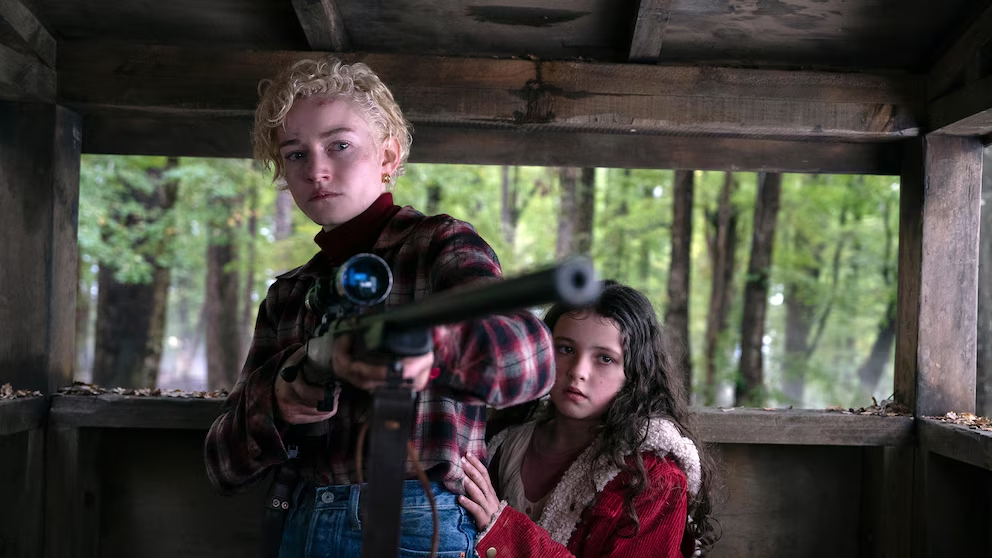
Blake Lovell (Christopher Abbott) is a struggling writer in New York City who spends most of his time with his young daughter, Ginger (Matilda Firth). At the same time, his wife/her mother, Charlotte (Julia Garner), navigates a busy work schedule as a journalist. Their marriage is going through a cold spell (with a dash of passive-aggressive hostility), with Blake emotionally closer to their daughter and the frustrated Charlotte admittedly at a loss as to how to connect with Ginger. One day, Blake receives an envelope that finally confirms the official death of his estranged father, Grady, who’s been reported missing in rural Oregon for years. He’s left with the keys to the family farmhouse where he grew up, surrounded by a dense forest and not associated with the best childhood memories.
Believing this to be a good opportunity for the family to unplug and reconnect, Blake convinces Charlotte to take time off work and visit the property in Oregon. This becomes a relocation, with the family packing everything into a U-Haul moving truck and driving to the property. It seems odd that Charlotte would agree to uproot without Blake checking out the location in advance, but this screenplay isn’t concerned with that type of relationship logic. The concern is rather fast-tracking the characters to the primary location where they will encounter the titular character.
As the Lovell family gets closer to their destination, they become pretty unnerved and suspicious of their environment, primarily because Blake hasn’t been since he was a boy. This feeling is affirmed when they meet Derek (Benedict Hardie), a local who’s lived next to Blake’s father’s property all his life. This rifle-toting local is a little off, or maybe Whannell just wants to offer a red herring before things get hairy. At least he advises the family to make sure they don’t wander outside after sunset as he guides them to the location of his father’s place. As the truck moves on, Blake swerves to avoid hitting a creature that stands on two legs, causing the vehicle to crash into the woods, where this creature attacks them, leaving Blake with a deep scratch on his arm.

The frightened family barely makes it inside the farmhouse as the creature pursues them from the woods. While they barricade the front door and listen for any exterior activity, Charlotte begins to realize that a new threat will be coming from inside the home. Blake shows signs of illness and then a beastly transformation. Without knowing what’s happening to her husband, Charlotte must figure out if there’s any way to help him while protecting their daughter if she can’t come up with any solutions.
“Wolf Man” steers clear of any curses, mysticism, or silver bullets that have been staples in previous wolf man movies, but it does open up with a bit of background and a brief text that the audience can read. It describes how, back in 1995, a hiker went missing in the mountains of Oregon, and eventually, there would be multiple sightings of the man by locals. Speculation got around that he had contracted an animal-borne virus referred to as “hills fever,” which the Indigenous people of the area knew by another name: ma’iingan odengwaan, or “Face of the Wolf.”
That’s an interesting set-up, if Whannell and Tuck were to expand on any of that. Since we only meet one local in the movie, there’s no chance of exploring this legend that’s been around for decades. It’s just a way to explain how this iteration of the wolf-man story won’t include some of the expected elements of a wolf-man story. That’s fine with me, that is if you’re going to incorporate what you’re introducing throughout the rest of the movie, but that doesn’t happen here. I would’ve welcomed an incorporation of Indigenous lore surrounding this “Face of the Wolf” condition, but we don’t get that here. It’s curious to open the movie in such a manner, but provide no follow-through or connection in the subsequent story.

That being said, the movie spends a good amount of time in 1995 when we meet Blake as a young boy and learn of the relationship dynamic he had with his father. Their relationship is troubling, with the intense Grady (Sam Jaeger) instilling Blake (Zac Chandler) with survival lessons often taught during nearby deer hunting trips. Within this backstory, we discover, as does young Blake, that his father was well aware of the rumors of a werewolf creature in the area and determined to kill it to protect his son and others. When we catch up with Blake thirty years later, he’s gone out of his way to be the opposite of his father in his relationship with Ginger. He’s chosen tenderness and playfulness to connect with his daughter, pledging to protect her at all costs. At times, his fear of being unable to fulfill that pledge manifests itself in angry outbursts similar to his father, but Blake sees that and is quick to apologize.
The problem with this first act of “Wolf Man” is that it predicts what’s to come once Blake is struck by the local lycanthrope. That was apparent to me even before the movie ended. Just about every beat, sometimes specific camera shots from cinematographer Stefan Duscio (who also lensed “The Invisible Man” and “Unhinged” for Whannell), are revisited during the following two acts of the movie. One key sequence involving a transformed Blake wrestling with the wolf man who infected him results in a moment that’s supposed to be a surprise, but alas, that revelation was predicted. The foreshadowing and repetition in “Wolf Man” prevent full immersion for the viewer, often creating unintentionally humorous moments that should be heightened by intensity.
As for Whannell’s take on body horror and man-wolf transformation, some unique aspects are included that make this movie stand out from others. Some of that is in the script, and the rest can be found in the different approaches Abbott takes to the stages of Blake’s turn. Abbott conveys moments of confusion as his senses are heightened (there’s a great scene involving a spider crawling up a wall), and sound and vision come into play in innovative ways when Blake loses the ability to understand Charlotte or Ginger when they talk to him, as well as a cool animal POV that provides a striking (albeit slightly overused) viewpoint that’s rarely been done.
Overall, the makeup and effects employed to transform Abbott’s Blake are well done, with the actor often resembling Lon Chaney in body language to communicate his loss of humanity. The most suspenseful scene of the movie involves a nighttime encounter in the nearby barn that utilizes darkness to significant effect. The gore is never at the level of Cronenberg’s “The Fly” or Landis’ “An American Werewolf in London,” and that makes sense considering there should still be a semblance of a man in the protagonist, hence the title.
“Wolf Man” is better than most January horror releases, but its predictability and repetition are unfortunately way too noticeable. The only surprise about the movie’s ending is how it neuters any chance of a sequel.
RATING: **


