DROP (2025) review
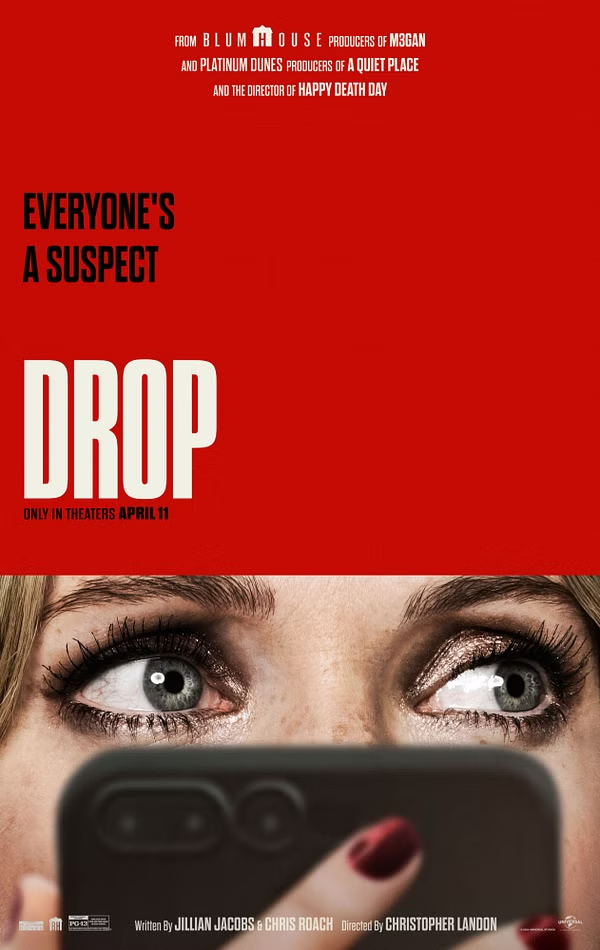
written by: Jillian Jacobs and Chris Roach
produced by: Michael Bay, Jason Blum, Brad Fuller, and Cameron Fuller
directed by: Christopher Landon
rated: PG-13 (for strong violent content, suicide, some strong language, and sexual references)
runtime: 95 min.
U.S. release date: April 11, 2025
We’ve all been on a bad date. It would be hard to know what a good one is if we hadn’t. The thriller “Drop” takes place on a first date that will likely remind viewers of their worst dates over the years. While watching, you’ll probably wind up looking at your watch or rolling your eyes, just like you would on a bad date. It’s the third of six movies from Blumhouse, a production company that continues to saturate the market with genre offerings yearly. It’s directed by Christopher Landon (“Happy Death Day” and “We Have a Ghost”), who’s been involved in many horror flicks or thrillers (most for Blumhouse) over the years as either a writer, producer, or director. The overall conceit of the thriller, from the minds of screenwriters Jillian Jacobs (“Fantasy Island”) and Chris Roach (“Truth or Dare”), should warrant a tautly wound thrill ride. Instead, we got a haphazard, wanna-be Hitchcockian tale that tries too hard to be slick and clever.
The movie opens with an alarming domestic abuse scene, where a woman is desperately trying to escape a brutal attack from a gun-wielding man. She is seen bloodied and battered, crawling away from him on the floor as he violently kicks her and then corners her at gunpoint. He appears frantically worked up and disturbed and strangely offers her the gun, giving her the choice to pull the trigger on him.

Landon and editor Ben Baudhuin quickly cut to a noticeably calmer scene as we catch up. with that woman, whom we’ll comeet (Meghann Fahy, “The White Lotus”), a widowed mother and therapist. She is conducting a telehealth therapy session from her spacious Chicago home, where she lives with her young son, Toby (Jacob Robinson, apparently a TikTok sensation). Later on, her sister Jenn (Violett Beane) arrives to babysit and offer unsolicited outfit advice for Voilet’s date night. After much hesitation linked to her past relationship experience, Violet is putting herself out there again going on her first date in some time. Naturally, she’s nervous about it, but she probably has more butterflies than usual, considering this will be the first time meeting a guy she’s been communicating with online for a while.
The guy is Henry (Brandon Sklenar, “1923”), and while she’s on her way to the fancy top-floor skyscraper restaurant called Palate, Violet receives a text that he’s running late. This allows Violet time to gather herself and sit at the bar while waiting for her date. It also allows viewers time to get acquainted with Violet’s surroundings just as she is, which includes certain idiosyncratic characters that either work there or are patrons like herself. Violent meets the side-eye glaring hostess (Sarah McCormack), the observant bartender (Gabrielle Ryan Spring), and the creepily flirty new piano guy (Ed Weeks). She also engages with Richard (Reed Diamond), who initially mistakes her for his blind date and then divulges how nervous he is. Now, I know Chicago is a friendly city, but it already seems like the people (obvious red herrings) around Violet are overly extroverted here.
It’s around this time that Violet starts getting DigiDrop messages to her phone, which will play a significant factor throughout the rest of the movie. At first, these drops (what iPhones call AirDrop and Androids refer to as Quick Share) are innocuous memes, inviting Violet to “Accept” or “Decline,” yet she has no idea who it’s from. The whole process seems foreign to Violet, someone who you think would fortify a wall of privacy settings on her phone that would prevent her from exposing her identity or receiving unwarranted drops. But here we are, and that’s why the movie is called “Drop”.

When Henry arrives, he apologizes for his lateness, and the two are seated at a table with an expansive view of the city (a skyline that clearly isn’t Chicago). As the pair shake off initial awkwardness, Violet asks Henry if it’s alright that she keeps her phone on the table since she hasn’t been away from Toby in a while. Of course, he’s understanding and comes across as a nice guy. We learn Henry is a photographer who works with the mayor’s office in some fashion because, for some reason, he feels he has to apologize for bringing his camera along. They are greeted by an overly enthusiastic waiter named Matt (Jeffrey Self), who winds up being another character who overshares. It’s his first shift, and he’s taking classes at Second City. His schtick is delightfully quirky at first, and then it’s just annoying.
After getting a couple of text check-ins from her sister, a distracted Violet starts getting more DigiDrops and, soon after, some threatening messages from an anonymous sender. This is when she shares with Henry that she’s been getting these weird messages since she arrived. He kindly mansplains that whoever is utilizing the drop-sharing technology can find her on the app and must be within fifty feet. At no point do we suspect Henry could be a viable candidate for this strange sender, but that’s one of a handful of missed opportunities in “Drop”.
Violet becomes visibly concerned as the messages get more personal and threatening, looking around to see who could be sending them. They say they see her and are watching every move, and if she doesn’t follow instructions, her son will be hurt. This is confirmed when she finds a masked intruder while checking her home surveillance footage app. Now it’s all getting chillingly real. To make matters worse, the messenger tells her she cannot let anyone know, especially Henry, about the messages and especially the instructions she’s given. Some of the more specific instructions Violet is given involve Henry, such as stealing and smashing his camera’s SIM card and pouring a Sertraline/Fentynal cocktail into his drink…or else her sister and son are dead.

Undoubtedly, all of this will be riveting for some, but it wasn’t long before I found myself bored and annoyed by the whole thing. Fahy and Sklenar have palpable chemistry, but that’s not enough in a movie like “Drop,” where the conceit of technology being a threat is supposed to be the compelling threat of the mystery. The problem is how it goes about it. To mix it up and make the visuals dynamic, Landon broadcasts the texts Violet receives in dramatically oversized font projected across the screen as if they’re opening credits. It’s a ripcord effect that pulls us out of the immediacy of the digital threat posed to Violet. It’s better than cutting to her phone screen each time she gets a text, but it’s still both pretty distracting and disorienting.
As the movie unfolds, the plot becomes repetitive, bouncing between Violet trying to follow detailed rules and excusing herself from the table to follow them. The more time she leaves Henry at the dinner table, the more I think how ludicrous this is. Any other dude would’ve left, and at one point, Henry does, yet Violet is required to keep him there, which is probably one of the best scenes.
There seems to be a lack of desperation in “Drop,” especially as the tension ratchets into the climatic third act. Despite Landon’s attempt at visual flair, the overall viewing experience lacks the genuinely engaging energy needed for such an endeavor. At times, “Drop” is reminiscent of similar albeit better thrillers, such as “Red Eye” (2005) and “Phone Booth” (2002), with a dash of the seldom-talked about 90s thriller “Nick of Time.” Still, the clunky, convoluted, and contrived narrative induces a frustratingly eye-rolling effect. Granted, I haven’t been on the dating scene in over 20 years, but there’s no way I’d stay around for this particular date.

RATING: *1/2


