SINNERS (2025) review

written by: Ryan Coogler
produced by: Zinzi Coogler, Sev Ohanian, and Ryan Coogler
directed by: Ryan Coogler
rated: R (for strong bloody violence, sexual content and language)
runtime: 137 min.
U.S. release date: April 18, 2025
Ryan Coogler has directed five movies so far, and each has been great, if not good. Four of them have starred Michael B. Jordan, all in lead roles save for one in a cameo, and were composed by Swedish composer Ludwig Göransson. They revitalized the “Rocky” franchise with 2015’s “Creed,” and they delivered one of the best MCU movies in 2019 with “Black Panther”, and their latest endeavor is “Sinners,” an impressive period genre film he also wrote and co-produced. It’s proof that these three artists should continue to work together as much as possible. Free of the confines of IP, Coogler takes an assured, unique approach to genre filmmaking by focusing on character details and music of the Mississippi Delta in the early 1930s, gradually building to some bloody and thrilling vampire action. “Sinners” is sweaty and sensual, paying homage to paranoid horror thrillers, with a spot-on sensational ensemble cast that benefits from Coogler’s confident vision and rhythm.
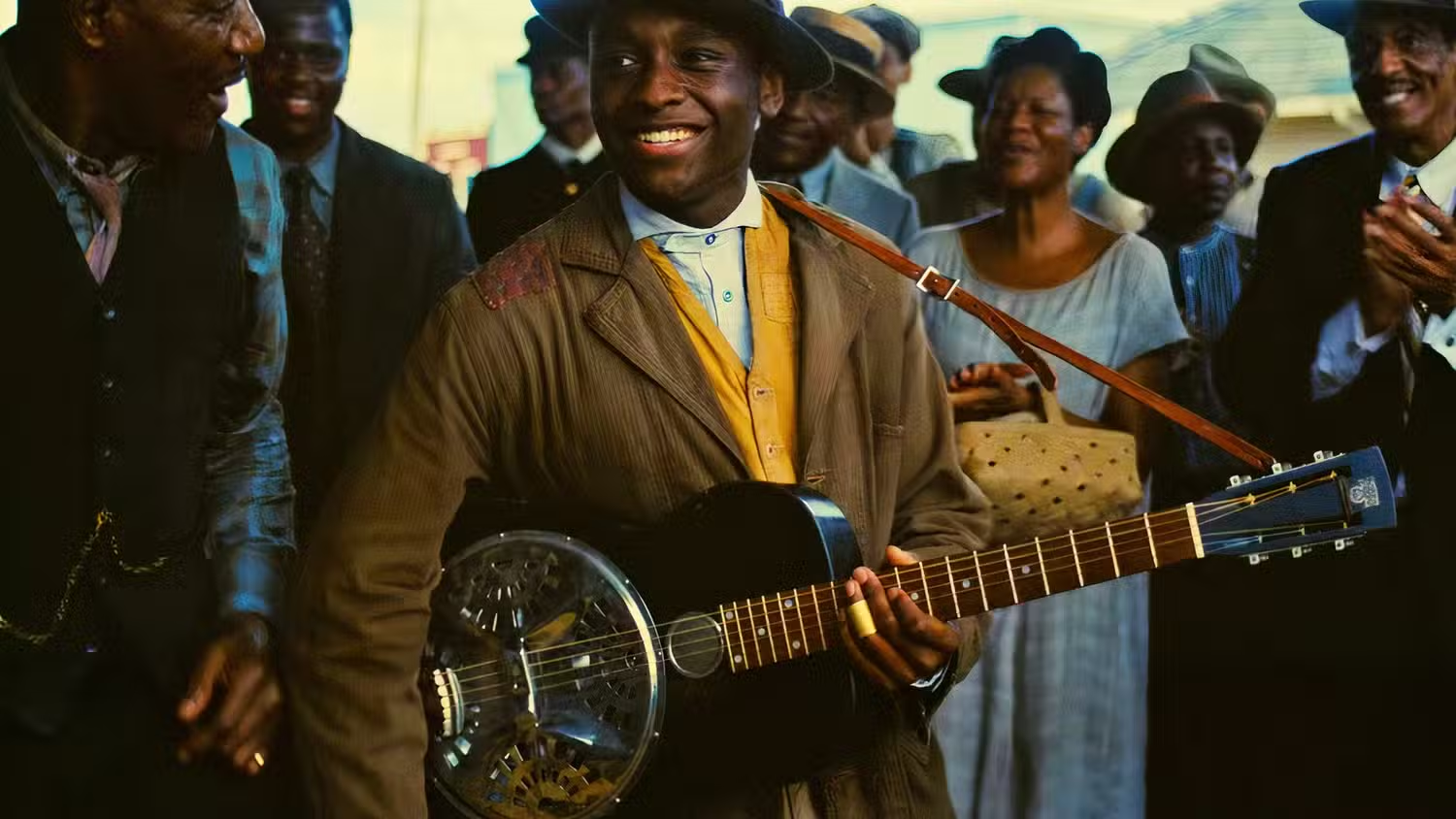
The movie opens with a foreshadowing prologue, where we find a desperate and injured young black man hopping out of a vehicle and limping his way into a quaint rural church, gripping the snapped neck of his precious guitar. The service suddenly stops as the preacher’s son, Sammie Moore (Miles Caton), approaches his father, Jedidiah (Saul Williams), as the startled congregation looks on. Flashes of violent and bloody images with glowing red-eyed figures interject the father-and-son moment, and then we cut to what transpired twenty-four hours prior.

The year is 1932, and twin brothers Elijah “Smoke” Moore (Michael B. Jordan) and Elias “Stack” Moore (also Jordan) have returned to their Clarksdale, Mississippi home after working under Al Capone in Chicago. With a load of cash and plenty of Irish beer, the brothers purchase an abandoned sawmill from local KKK leader Hogwood (David Maldonado) to create a juke joint for locals. To do this, they split up to recruit the help they’ll need to make the most of the joint, teaming up with their blues-playing kid cousin, Sammie. Stack and Sammie make their way into town and recruit alcoholic bluesman, Delta Slim (the always welcome Delroy Lindo), luring him with the promise of plenty of booze. At the same time, Sammie is enamored by singer Pearline (Jayme Lawson), inviting the young married woman to opening night. Smoke visits married couple Grace (Helen Hu) and Bo Chow (Yao), shopkeepers who can supply the catfish and other delicacies, and persuades old flame, Annie (Wunmi Mosaku, an absolute standout), gifted in hoodoo conjuring, to work her magic in the kitchen. Cotton field worker Cornbread (Omar Miller) is also convinced to leave his job to serve as a bouncer at the juke joint. Then there’s the biracial, white-passing Mary (Hailee Steinfeld, in her most adult role to date), a jilted lover who wrestles with bitterness and longing for Stack.
Everything seems to be coming together for the brothers Smokestack, who plan on unveiling the grand opening later that night, but there has to be a wrench thrown into their plans, or else there’d be no challenges or stakes. That comes in the form of a drifter named Remmick (Jack O’Connell), an Irish vampire who aims to build a flock by drawing others with the promise of “fellowship” and “community”. He arrives at the juke joint with local KKK couple, Bert (Peter Dreimanis, lead singer of Canadian alternative band July Talk) and Joan (Lola Kirke), whom he recently turned, drawn by the rollicking music from within the goal of charming and feeding on everyone inside.
If you were to explain to someone what “Sinners” is about, when you get to the vampires (you kinda have to), you’ll get a look of puzzlement. It’s understandable considering most folks will find it an incredulous development. Still, Coogler makes it all work by focusing on characters and gradually laying out a believable mystery, despite the looming presence of the supernatural throughout.
Much is established in “Sinners” before we get to Remmick asking to be invited to the juke joint. The temperature rises as the story unfolds, delivering a sweaty and lustful eroticism (quite rare in the current moviegoing climate) that’s surrounded by an infectious musicality. The music peaks during a bravura sequence where Sammie’s blues guitar playing and Pearline’s singing conjure a dreamlike hallucination connecting the traditions of the past with the promise of the future. It’s a potent and spellbinding sequence that spotlights the Black Experience (like all of Coogler’s movies), Chinese history, First Nation warriors, and the transportive power of music.

The way Coogler introduces Remmick is visually striking, hinting at certain vampire trademarks that will play out later. The character seemingly drops out of the sky, his flesh scalding from the sunlight, as he’s chased by a group of Choctaw vampire hunters who know enough to turn around as dusk approaches. O’Connell nails the Irish charm of the character, who has seemingly been whatever he needs to be to entice his targets for hundreds of years. He doesn’t come across as a nefarious threat, but more of a creepy manipulator, with the horror being how easily he can influence his prey to join his side. One scene involves Remmick performing a jig that resembles what Michael Flatley does in the Riverdance musical. It’s a bit that runs a tad too long, in a movie that is overall quite commanding and often subverting audience expectations despite paying homage to movies like “From Dusk Till Dawn” and “The Thing” (and maybe even Italian horror films of the 1980s).
The strength of the ensemble cast is unmistakable in “Sinners”, so when it comes time to watch the motley crew take a stand against the vampire threat, we’re easily invested. We understand their panic, confusion, and steely resolve. It’s not a surprise that Jordan delivers an incredible dual performance (in a year that has already seen Robert Pattinson and Robert De Niro do double duty in their own movies) that offers enough personality distinctions between Smoke and Stack to easily keep track of who’s who. Caton, known chiefly for his singing (he toured with H.E.R. as a background vocalist), winds up becoming a revelation here, serving as our gateway character that carries into the end credit sequence, which is simply one of the most fitting codas to a movie that I have ever seen.
This is the first original material Coogler has tackled since his 2013 debut, “Fruitvale Station,” and he tells his story with rich cinematic language and bold big swings. All the design aspects of the movie are superb, and how cinematographer Autumn Durald Arkapaw (who lensed Coogler’s last movie, 2022’s “Black Panther: Wakanda Forever”) utilizes 65mm IMAX and Ultra Panavision 70 is simply stunning. Every framing decision is visually captivating, providing many memorable shots that contribute to “Sinners” being one of the best-looking genre pictures in some time.

Back to the music, composed by Göransson and produced by his musician wife Serena, which is a crucial part of “Sinners'” success. Drawing inspiration from blues innovators like Robert Johnson and Tommy Johnson, Göransson performed much of the score on erformed the score on a 1932 Dobro Cyclops resonator guitar, the same one Sammie uses in the movie. Besides Göransson’s score, “Sinners” also includes songs by the likes of Bobby Rush, Brittany Howard, and Buddy Guy, to name a few, and they all fit seamlessly and are part of a soundtrack worth repeat play.
“Sinners” is an exhilarating viewing experience from start to finish, even if some parts are lengthy. Coogler confidently combines many elements and themes to remind us how pain and pleasure can bring people together in sudden and unexpected ways. Like us, the characters in “Sinners” are all sinners in some respect, yet they have a fascinating way of coming together, whether for worldly pleasures, identity preservation, or love.

RATING: ***1/2


Trackbacks