IT’S NEVER OVER, JEFF BUCKLEY (2025) review

produced by: Amy Berg, Ryan Heller, Christine Connor, Mandy Chang, Jennie Bedusa, and Matthew Roozen
directed by: Amy Berg
rated: not rated
runtime: 107 min.
U.S. release date: August 8, 2025
When I first heard his voice in 1994, I didn’t care who his father was or where he was from. I just wanted more Jeff Buckley music in my ears. That was the year his album “Grace” was released, and it would wind up being one of the greatest debut albums ever. His voice had a range like few others, and when he paired it with his guitar playing, Buckley sounded otherworldly. Sadly, “Grace” was the only album the world would get out of Buckley, because he died in 1997 at the young age of 30 after accidentally drowning in the Mississippi River near Memphis, where he had just started recording his follow-up album. It’s insane that some only know him for his cover of Leonard Cohen’s “Hallelujah”, and that’s why it’s a good thing director Amy Berg made “It’s Never Over, Jeff Buckley”, a documentary which celebrates his life and music, providing a viewing experience which will enlighten those who hardly knew him, and inspire them to seek out Buckley’s music for the first time and for that I am envious.
Berg assembles an assortment of people who knew Buckley for the documentary, including family, friends, and former girlfriends. The talking head moments that are sprinkled throughout, including musicians Ben Harper and Aimee Mann, provide us with a greater understanding of who he was as a person, beyond his musical persona.
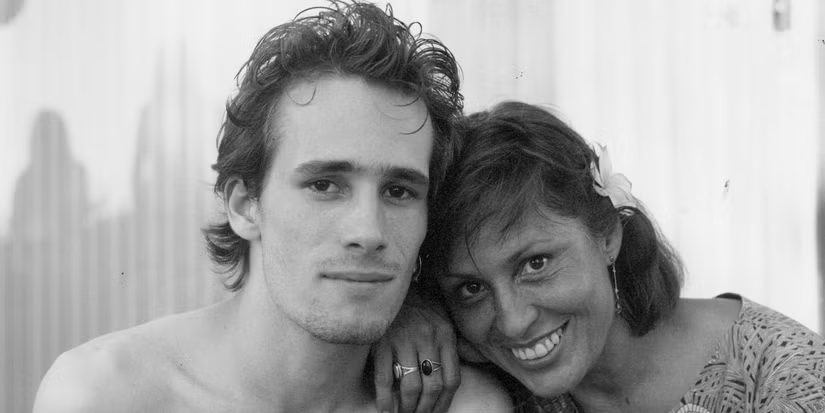
Right from the start, Berg spotlights three women who knew Buckley intimately, subverting expectations of typical documentaries revolving around musicians. Rebecca Moore dated him in the early nineties and lived with him in New York City. She was an artist then, but admits that she abandoned that whole scene after Buckley died. Joan Wasser was a fellow musician and singer who had a relationship with Buckley as well. As she shares, she wells up in tears as she shares how she hasn’t been able to listen to anything from his incomplete second album. Then, of course, there’s Buckley’s mother, Mary Guibert, who clearly knew him the longest and shares how Jeff started singing as a child. She was 17 years old when she conceived him in Anaheim, California, and the two of them wound up raising each other. Meanwhile, Jeff’s father, Tim, couldn’t part with his vision of being a singer/songwriter to play an active part in Jeff’s life.
Tim Buckley did indeed go on to become a well-known figure in the folk rock community, releasing nine studio albums that found him experimenting in multiple music genres. Jeff eventually met his father following a concert in Southern California. He even went home with his father and stayed with him a while, but that didn’t last long, and soon young Jeff was on a bus back to his mother. Not long after that time, Tim died of a heroin overdose at age 28. When Jeff started on his own as a musician, it was hard to shake off the legacy of his father and inevitable comparisons, as well as the notion that he probably wouldn’t live that much longer than his father did.
Berg includes old home video clips and personal photos that show Jeff at a young age, developing his voice and musical tastes. Early on, he would listen to the likes of Led Zeppelin, The Who, Queen, and Pink Floyd. He had the incredible knack for picking up certain guitar styles early on, like jazz fusion guitarist Al Di Meola. We hear interview clips of him talking about how he was influenced by a handful of female musicians, such as Nina Simone’s vocals and Siouxsie Sioux’s, and the lyrics of Joni Mitchell and Patti Smith. He was also a massive fan of the late Pakistani Qawwali singer Nusrat Fateh Ali Khan, someone he would eventually meet. When you learn this and hear Buckley’s impassioned vocals, it all makes sense. These artists do not just influence him, it’s as if they enter him and out comes a transformative mixture of how he hears and feels them, combined with his heart and soul.
After playing a variety of musical styles in Los Angeles, including reggae, jazz, and heavy metal, Buckley started making a name for himself after he moved to the Lower East Side of Manhattan. In 1992, he became a regular feature on Monday nights at Sin-é, a local cafe and music venue, where he would try out a variety of rock, blues, and jazz covers, eventually debuting original material as well. These shows would become so popular that they earned the attention of record producer Clive Davis, among other notable industry figures.
Jeff was keenly aware of the comparison to his father’s legacy during this time, and Berg shows some of that struggle here. There are interviews with others about the subject and one clip with Buckley where one interviewer asks what he inherited from his father, and he immediately responds, “People who knew my father.” We’ll never really know how much of his fractured past with his biological father impacted Buckley. Still, it likely contributed to his struggles with anxiety and depression, just as the meteoric success and exhaustive tour from “Grace.”

The mystery surrounding Buckley’s death on May 29th, 1997, could be a documentary in and of itself. Those who are already well-informed won’t learn anything new from Berg here, mainly because there’s been nothing new about the tragic event. It was an accident. Sure, one could delve into the interviews Buckley took part in immediately preceding his death to glean any indication of the reason for his death. Buckley can be heard mentioning suicide after he’s asked about the progress of his follow-up album, and when asked where he envisions himself in ten years, he states all he sees is a blank screen. Neither of those responses cast any light on Buckley’s death. If anything, they are relatable and understandable responses of an artist who feels the pressure of creating in the wake of success. After all, not many young artists have a clear picture of what their lives will look like in ten years.
One thing surrounding his death that I forgot about was how some folks wanted to connect Jeff’s young death to his father’s young death. Berg includes an interview with one of Jeff’s friends and former bandmates, who shares his frustration with a significant music publication hinting that drugs or alcohol were involved in his death. When an artist dies with such untapped potential, speculation runs rampant. That benefits no one.
Regardless, the artist’s work lives on, and it always will. “It’s Never Over, Jeff Buckley” ultimately serves to celebrate Buckley and provide another way to keep an awareness of his immense talent alive. Including those who knew him, especially the three aforementioned women, provides a potent emotional layer that’s welcome. What I appreciate most about Berg’s documentary is that it allows us to spend time with Buckley once again. To hear Buckley’s voice and see him perform is a gift, and to be able to revisit it at any time is a gift that keeps on giving.

RATING: ***


