Oscar-Nominated Live-Action Shorts (2026) review

It’s a strange surprise that none of this year’s Oscar-nominated Live-Action shorts stand out or are as impressive as they should be. They should be because they’re Oscar-nominated. Granted, none of them are bad, but I expect to be wowed or impressed by a Short that receives an Oscar nomination. Only one piqued my curiosity and had me thinking; the other four were fine or good. Many of these nominees have toured the festival circuit in the past year after their world premieres at the Tribeca Film Festival, South by Southwest, and the Toronto International Film Festival, and now they are getting a theatrical release thanks to Roadside Attractions, leading up to the March 15th Oscar telecast, where a winner will be announced.
Below are my thoughts on each nominee, ranked from “good” to “fine”…

TWO PEOPLE EXCHANGING SALIVA
Since when does France have intimacy issues? Last year, there was “Yuck!”, an Oscar-nominated animated short about children recoiling from witnessing people kissing at a campground until two of them discover just what all the fuss is about. This year, Natalie Musteata and Alexandre Singh (partners in work and real life) have written and directed “Two People Exchanging Saliva,” a black-and-white drama that takes place in a dystopian Paris, where kissing is so aversive that those who are caught in the act are put into a coffin and hurled over a cliff. We learn this during the opening of the 36-minute short, where we see a plain wooden coffin being carried away as a woman’s muffled cries can be heard from the inside. It’s an easy attention-grabber that carries through three chapters. “Le Jeu” (“The Game”) is the first chapter, introducing viewers to Malaise (Luàna Bajrami, “Portrait of a Lady on Fire”), an upbeat twentysomething starting her first day at a department store. A melancholic and playful narrator (Vicky Krieps) describes Malaise as a naïf shopgirl with sparkling eyes, which humorously counters the meaning of her name. In fact, all the characters are named after different states of bad humor. It’s difficult to figure out what is going on in this bleak environment, where customers are given a breath test by security before entering the boutique (and the assumption is they pass if they have bad breath), and garlic gum is encouraged, but we soon learn that currency is replaced by slaps to the face. The more bruises on your cheek from slaps, the more affluent or bourgeois you are. We learn this in the second chapter when Malaise dons a bejeweled glove and slaps customer Angine (Zar Amir Ebrahimi, “Holy Spider”), someone she develops an infatuation with. The elegant and unhappily married Angine used to be a frequent customer of Malaise’s supervisor, Pétulante (Aurélie Boquien), but switches when she notices Malaise has a knack for picking out just the right items for her. This makes the insecure Pétulante envious, and she keeps an even closer eye on Malaise, even overhearing her brushing her teeth in secret. I guess not taking care of your teeth in this society is a way to prevent kissing, which makes me wonder if dentistry is even a thing. By the third chapter, a dual heartbreak occurs surrounding Malaise’s 25th birthday. Musteata and Singh have created a unique story that only vaguely touches on how real-life stories of queer love have been scrutinized in society lately. Their surreal and satirical take boasts eye-catching minimalist production design with intriguing cinematography. Produced by The New Yorker, it’s the longest short in the category, and my favorite for being quite different. I can’t help but think that expanding to feature length would allow for more breathing room and added dimension.
RATING: ***
A FRIEND OF DOROTHY’S
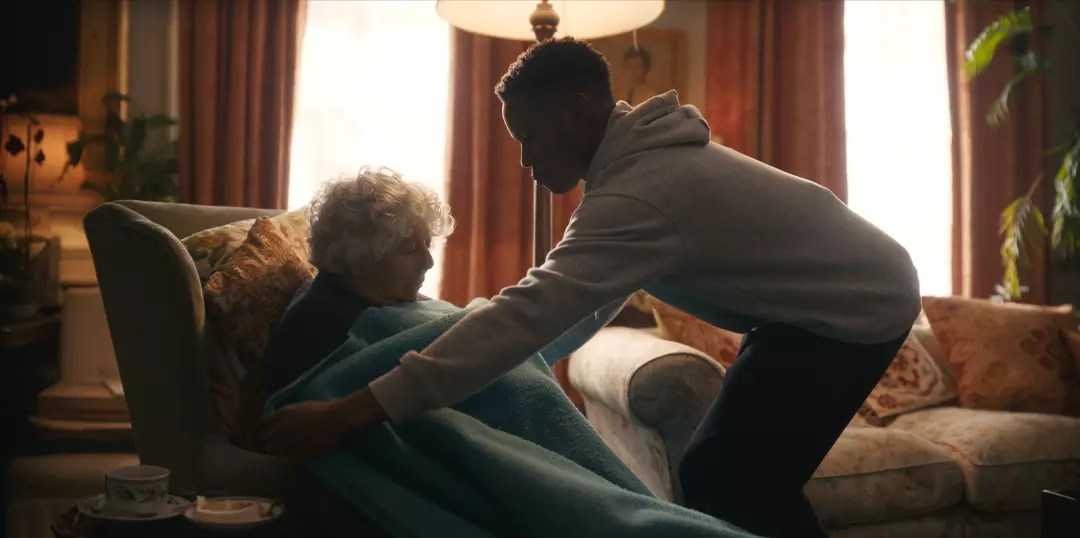
British writer/director Lee Knight loosely draws on his own experience with “A Friend of Dorothy’s,” a sweet dramedy about a young Black English teenager named J.J. (Alistair Nwachukwu) who befriends Dorothy Woodley (Miriam Margolyes), a lonely 97-year-old woman who is still full of life. They develop an unlikely kinship after he accidentally kicks his football into her backyard wysteria. The curious and comical woman invites him in, hoping the young man can open a can of the daily prunes she requires for her bowels. He does, and in turn, she opens up a space for him to be seen and free. Inevitably, they learn about each other. She is a longtime appreciator of the arts, and he is passionate about theater (though he has hidden it by playing football) and is enthralled by her library of plays. He winds up visiting her every afternoon, which finds her sipping tea while he acts out a monologue of her choosing. The heart of the story is a flashback bookended by a meeting in which estate executor Dickie (Stephen Fry) sits down with J.J. and Dorothy’s spoiled and arrogant grandson, Scott (Oscar Lloyd, resembling a young Trump), who rarely visited his grandmother and knew nothing of her friendship with J.J. Margolyes and Nwachukwu have a charming chemistry, and there story probably didn’t need the executor and the grandson, but it serves the purpose of framing the 21-minute story. Knight has a meaningful friendship with his neighbor, someone who accepted him and his husband, so the subject is personal to him, and it shows. The writer/director likely knew Margolyes from their work in the “Harry Potter” series, and the veteran British-Australian actress definitely winds up being the highlight of the short.
RATING: ***

BUTCHER’S STAIN
24-year-old New York native Meyer Levinson-Blount has lived in Israel for over a decade and is finishing film school at Tel Aviv University. His first short film, “Butcher’s Stain”, earned him a silver medal there, and it was then nominated for an Oscar. How cool is that? The 26-minute film is set after the Oct. 7, 2023, terror attacks in Israel and Palestine, and follows Samir (Omar Sameer Mahamid), an exemplary Palestinian butcher who finds himself falsely accused (the titular stain) of tearing down hostage posters in the breakroom of the market where he works. He’s well-liked by his Israeli co-workers, but when he’s called into his manager, Michal (Rona Toledano), to discuss the accusations, Samir is distraught and insulted. He’s also frustrated, as he desperately needs the job to provide for himself and his young son, who spends most of his time with his mother, Samir’s ex-wife. The owner is the manager’s father, who tells her they have no evidence and would rather not let Samir go. When Levinson-Bount reveals the accuser and the truth behind how the hostage posters continuously wind up on the break room floor, it is too late. Here is another personal tale, finding Levinson-Blount using his own work experience at a supermarket, where he often saw the trauma of the strained Israeli-Palestinian relationship play out. The characters’ anxiety and scrutiny are palpable, and Levinson-Blount does a convincing job of creating an emotional and human connection with the audience.
RATING: ***

THE SINGERS
“The Singers” is the lone Netflix-produced offering in this category, and it plays like a stretched-out Super Bowl commercial. That’s not necessarily a slight, since some of the best, most memorable commercials can be found on the NFL’s biggest night. The 18-minute short finds director Sam A. Davis adapting a 19th-century short story by Russian author Ivan Turgenev, in which downtrodden patrons commiserate at a lowly pub and unexpectedly connect through an impromptu sing-off. It’s a modern take, set in a nondescript dive bar where the clientele still chain-smokes. The patrons pretty much keep to themselves until the barkeep (Mike Yung, of America’s Got Talent, Season 12 fame, who sings “Unchained Melody”) announces that a singing contest, where the best singer will not only earn a free drink, but also the lone $100 bill among the hundreds of one-dollar bills tacked to the ceiling. The titular cast are actual singers, such as 81-year-old American folk/blues singer Chris Smither (“House of the Rising Sun”), 29-year-old Australian Judah Kelly (who won the sixth season of “The Voice Australia”), piano-playing blues singer Will Harrington (“It Hurts Me Too”), and opera singer Matt Corcoran, who belts out Vesti La Giubba from Leoncavallo’s I Pagliacci. The whole thing has a “you never know who you’re sitting next to” vibe for a certain subculture that parks itself at a bar, with a subconscious craving for connection. It’s good, but it doesn’t necessarily sing Oscar.
RATING: **1/2

JANE AUSTEN’S PERIOD DRAMA
There’s a lot of fun wordplay in this satirical look at the world of Jane Austen’s Pride and Prejudice, and the fun starts in the title, which has a humorous double-meaning once you realize what’s going on. Granted, it doesn’t take long to get what’s going on, and once that’s established, your mileage may vary. Set in 1813 England, the 13-minute short follows Miss Estrogenia Talbot (Julia Aks, who co-wrote and co-directed with Steve Pinder), who is taking a walk in her estate’s garden alongside her suitor, Mr. Dickley (Lachlan Ta’imua Hannemann), who is preparing to propose. When he takes a knee and prepares to present her with a ring, he is alarmed at the bloody streak that is on the front of her white gown. Thinking she is injured, he swoops her up, rushes her inside, and calls for a doctor. Her sisters, Labinia (Samantha Smart) and Vagianna (Nicole Alyse Nelson), panic when Essy wants to tell him the truth, advising her to say she ran into a bush. You can see how the short’s title becomes obvious right away, and how Aks and Pinder address the social stigma surrounding menstruation in a comedic manner. Is Dickley purposely ignorant, or did they not have sexual education back then? None of that is ever addressed, nor is there an expectation that it would. This is, after all, akin to an SNL sketch or a short that would play well before viewing the recent “Fackham Hall”, a feature-length period parody that came out a couple of months ago.
RATING: **

