


written by: David Zellner
produced by: Lars Knudsen, Tyler Campellone, Nathan Zellner, David Zellner, George Rush, Jesse Eisenberg & David Harrari
directed by: Nathan Zellner and David Zellner
rated: R (for some sexual content, full nudity and bloody images)
runtime: 89 min.
U.S. release date: April 12, 2024 (limited) & April 19, 2024 (wide)
“Sasquatch Sunset” is a film that was probably more fun for the actors to make than it was for viewers to watch. But then again, that depends on the viewer. After all, there’s an audience for everything, and if you’re into a lot of sasquatch grunting and groaning, along with fornicating and defecating, well, this is for you.
I’d be really curious to see (not read) the screenplay by David Zellner, who co-directed with his brother, Nathan Zellner. The entire film is dialogue-free, relying on a variety of grunting from four actors in Bigfoot costumes under a ton of hair and makeup work. The concept is interesting, but it would be better off as a quirky short. Stretching this material out to a feature becomes quite a tedious viewing experience.

Since there’s no dialogue, the characters we follow through four seasons (starting with Spring) have no names, at least none known to us. This initially finds us leaning in a little closer to differentiate who’s who and get acclimated to what the Zellners ask their viewers. At first, the furry Neanderthal creatures can wander a dense forest (presumably in the Pacific Northwest, but filmed in Northern California), searching for food. Still, we eventually see them notice life around them or groom each other. As we spend more time with them, we figure out that there is a Father (Jesse Eisenberg) and a Mother (Reily Keough), along with their offspring, Younger Brother (Christophe Zajac-Denek) and what seems like an elder family member (played by co-director Nathan Zellner). However, he’s questionably called Older Brother in the promotional info provided.
As the family navigates the wild, they must contend with nature’s unpredictability, where danger can reside alongside beauty. They develop a communication system involving banging rocks on trees and yowling, awaiting an auditory reply. It’s the only environment and existence they’ve known, and as far as they know, no other beings look like them. Life can be cut short quickly, or death can be drawn out; either way, the days continue.
One day, the Sasquatch family notices something they’ve never seen before: a large red X spray painted on the trunk of a tree. They are baffled. Then, they come upon a man-made road paved in asphalt. This is also a first for them. “Sasquatch Sunset” doesn’t see the family actually encounter humans, but the film ends, leaving us to believe that a meet-and-greet is just around the corner.
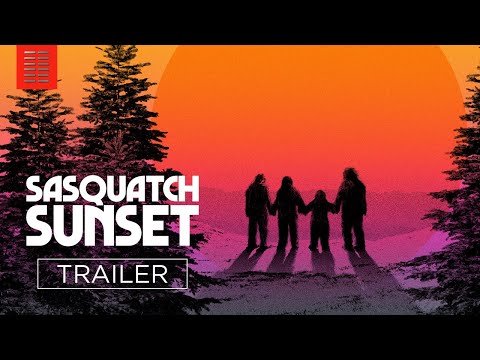
The Zellners set out to provide viewers with a behavioral journey, finding the cast lost in full-body suits and almost mime-like with its performances. In fact, Eisneberg, who also co-produced the film, invited mime and movement coach Lorin Eric Salm (whom he worked with on the French film “Resistance”) to work with the actors on their body language as they set out to resemble creatures somewhere between primates and humans on the evolution scale. When you think about what goes into such a performance, “Sasquatch Sunset” is impressive. However, as a feature-length film, it quickly becomes a tedious affair. With an abundance of bodily fluids on display – from lactation to vomiting, as well as the expected urinating and defecating – it doesn’t take long for the gratuitous approach to become juvenile.

It’s more interesting to see how these creatures use their minds in new ways. We start to see Eisenberg’s Father figure out how to calculate using his fingers, and the rest of them begin to use tree branches as tools. These kinds of breakthroughs are few and far between, unfortunately. More screen time is designated to Older Brother figuring out the different things he can do with his genitals or his reaction to a bad batch of berries. Very little of this is humorous, but it all seems to tickle the Zellners. To what end remains a mystery.
“Sasquatch Sunset” doesn’t get existential, nor is it interesting to delve into any parallels between Sasquatch and human behavior. Although I thought of the iconic opening of Stanley Kubrick’s “2001: A Space Odyssey” (1969) and the caveman life depicted in Jean-Jacques Annaud’s “Quest for Fire” (1981), the material here is all surface. That being said, the cinematography by Mike Gioulakis (“Up” and “It Follows”) is breathtaking, emphasizing the serenity of the a=denaw wilderness the quartet roams. Also notable is the score for the film, composed by The Octopus Project, an experimental trio that worked with the Zellners on their two previous films, “Kumiko, the Treasure Hunter” (2014) and “Damsel” (2017). Their score compliments our observational view of the Sasquatch family nicely, and the film’s closing credits song, “The Creatures of Nature,” is sung by Riley Keough, written by The Octopus Project and David Zellner.
Although humor is prevalent throughout “Sasquatch Sunset”, the Zellners treat life’s frailty seriously. The characters’ naivety finds them at risk when they stumble into unsuspecting peril. Still, there doesn’t seem to be enough at stake here (or in general) to make this a unique or satisfying viewing experience. Granted, it’s ambitious is obvious and one can easily appreciate what went into the production, but none of that is enough.
