


written by: Scott Silver and Todd Phillips
produced by: Todd Phillips, Emma Tillinger Koskoff, and Joseph Garner
directed by: Todd Phillips
rated: R (for some strong violence, language throughout, some sexuality, and brief full nudity)
runtime: 138 min.
U.S. release date: October 4, 2024 & October 29, 2024 (Amazon Prime Video, Apple TV+, Google Play & Fandango At Home)
I watched “Joker: Folie à Deux” on a Tuesday afternoon after the movie’s opening weekend and had the theater all to myself. Granted, that’s not the first time I’ve experienced a solo viewing in a multiplex, but considering this is the sequel to 2019’s “Joker” (also released in October), which became the first R-rated movie to make over a billion dollars and would go on to win two Oscars of its eleven nominations, it was sort of ironic.
Although director Todd Phillips’ box-office hit became quite the phenomenon, plenty of viewers still didn’t care for it. As one of those viewers, I can attest that this sequel, a jukebox musical psychological drama, actually made me appreciate “Joker: Folie à Deux”. It’s still unnecessary, but at least it’s more interesting than the previous treatment of the DC Comics Clown Prince of Crime.
That being said, “Joker” should’ve been a one-shot, but there’d be no possible scenario where Warner Bros. wouldn’t try to capitalize on the uncanny success of the first movie. Phillips took the popular Batman villain and set him in an alternate version of Gotham City (sans the Caped Crusader) and inserted the character in an amalgamated homage to Martin Scorsese’s “Taxi Driver” and “The King of Comedy.” Without shame, the movie attempted to mask its obviousness in slick cinematographer from Lawrence Sher (who returns for the sequel) while holding up a mirror to a destitute society of sin, anguish, and apathy.

But what if adding song and dance numbers to the melancholic milieu adds a welcome departure from the chain-smoking hard stares of the pathetic protagonist? You’ll find the answer to that question in “Folie à Deux.”
Why the fancy French subtitle, though, and not just “Joker 2”? This isn’t just your typical sequel (which is one of the reasons fans of the first movie aren’t taking a shine to it). “Folie à Deux” actually means a mental illness shared by two people in close association (thanks, Google), which makes sense, considering Joker finds a kindred spirit in this continuation.
Phillips and his co-writing pal Scott Silver pick up two years after “Joker” finds Arthur Fleck (Joaquin Phoenix) sitting in Arkham State Hospital, awaiting trial for the murder of five people. Among the victims was talk show host Murray Hamilton, an impromptu televised act enacted before a live studio audience. While the mentally ill nihilist was seen as an unhinged individual, Fleck’s lawyer, Maryanne Stewart (Catherine Keener), plans to argue that he has dissociative identity disorder and that his Joker personality is responsible for the crimes. That matters not to the rabid fanbase that has embraced the anarchistic violence they believe his Joker persona represents.
The walls of Arkham resemble a prison more than a hospital, with very little hope of rehabilitation. No doubt, Jackie (Brenden Gleeson), an abusive guard who physically torments Fleck, sees the incarcerated as nothing more than criminal scum. One day, while visiting a minimum security wing of the hospital, Arthur is transfixed by another patient, Lee (Lady Gaga). She’s there participating in a musical therapy group workshop, but we learn that she’s pretty obsessed with the media star that Fleck has become. Since Fleck is used to languishing in loneliness, he welcomes the attention of Lee, who is keen to reciprocate a relationship with the chanteuse.

Once the trial begins, assistant D.A. Harvey Dent (Harry Lawtey) aims to send Arthur to the electric chair for his crimes, but the trial takes an unexpected turn when Fleck chooses to represent himself. Between Arkham and the courtroom, Fleck retreats into a fantasy world where he partakes in song and dance numbers with Lee. That bleeds into the real world, with the couple often communicating in song, a welcome invitation for two troubled individuals to find common ground, acceptance, and a retreat from reality.
“Folie a Deux” immediately separates itself from its predecessor by opening with a Looney Tunes-style Joker cartoon short. It’s a surprising and darkly humorous reintroduction to the character, directed by French animator Sylvain Chomet (“The Triplets of Bellville”), bringing viewers back into the alternate Gotham created by Phillips and Silver. The gist of the short shows how Fleck is at odds with his shadow, a looming presence that represents his dark side. That also speaks to much of what is alluded to in this movie, where we’ll get a chance to understand the inner turmoil of the titular character possibly.
That being said, if you’re looking for humor in this Joker movie (imagine that!), it ends once this animated short is over. It’s back to the grimy, underlit Gotham that Phillips established in the last movie. “Folie à Deux” isn’t out to expand the setting, limiting the story to three locations: Arkham hospital, a Gotham courtroom, and the interior of Arthur’s mind.
At Arkham, we find the chain-smoking Arthur yearning for isolation and seeking peace, free from his fandom, which has turned him into something of a celebrity. Visitors are rare for Arthur, although TV personality Paddy Meyers (Steve Coogan) shows up to conduct an interview. However, within Arkham, he’s become just as popular with the inmates and staff. It’s not until he notices Lee that Arthur’s low affect begins to take an about-face.

Gaga’s Lee is far from the Harley Quinn character created by Paul Dini and Bruce Timm that debuted in the classic “Batman: The Animated Series”, nor is she resembling Margot Robbie’s humorous anarchist, and that’s a good thing. Just as Arthur Fleck’s Joker alter has nothing to do with any previous movie iteration of the classic DC Comics sociopath. Viewers who only know these characters from their big-screen appearances are likely unfamiliar with the fact that there have been a variety of comic book iterations for decades. So, for some viewers (like myself), seeing a different Harley and Joker is no big deal, in fact it’s a welcome approach.
The musical numbers in “Folie à Deux” add a welcome liveliness to Phillips’s dour tone. They also add a fascinating and curious layer to Arthur’s psyche, considering most of the musical numbers filmed are inside his head. These moments are filmed with the actors singing live, which lends spontaneity to the fantasy performances we see Phoenix and Gaga engage in. Together they perform covers of popular songs, such as “That’s Entertainment” and “Get Happy”, as well as “To Love Somebody”, somewhat of a deep cut from The Bee Gees, and a rousing rendition of “Gonna Build a Mountain”. Those numbers bring a surprisingly refreshing element to the movie, but the solos sung add an extra dimension to the Arthur/Joker character. We know from the last film that Arthur is a lonely and disturbed soul, but when he sings songs such as “When You’re Smiling” or “For Once in My Life,” it feels like a release, an outlet we haven’t seen before. Joker may be the makeup he puts on for an audience, but these songs come from within Arthur in a raw manner, meaning maybe they are the most authentic representation of who he is.
Don’t expect amazing vocals from Phoenix or Gaga here. After all, the characters they’re playing aren’t trained vocalists but troubled individuals who escape into a musical fantasyland. They don’t sound awful, just fitting. That being said, I’ve been returning to the soundtrack with all these songs and Gaga’s companion album “Harlequin,” which includes her take on many American jazz standards. The songs are contagious and enjoyable, with or without the context of the movie.
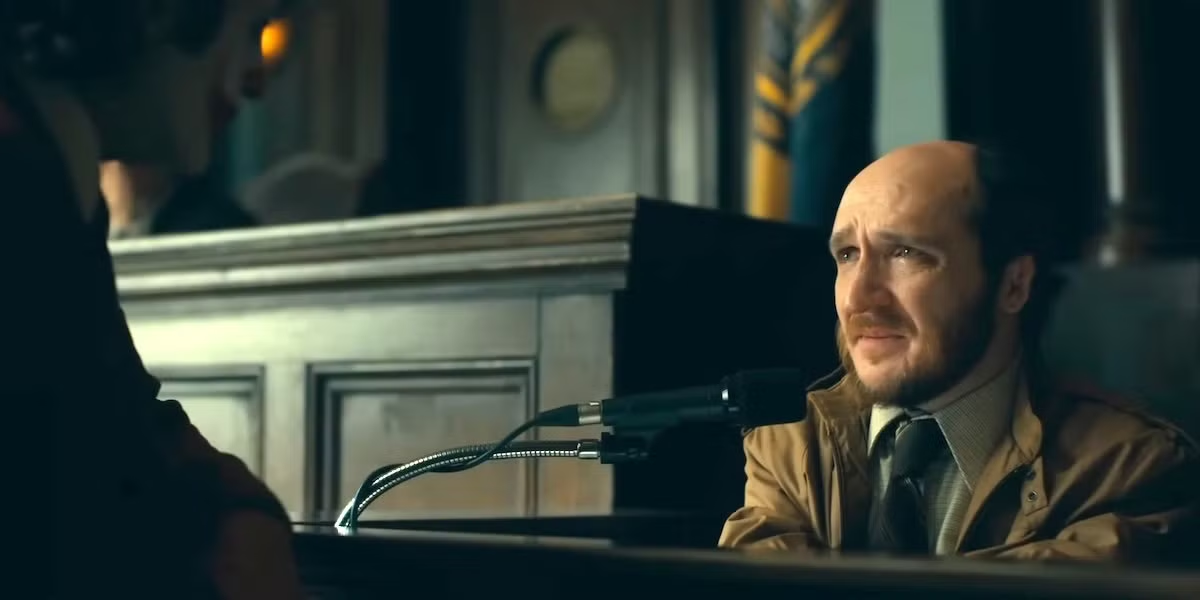
Most of the movie takes place in court and becomes quite interesting when Arthur decides to represent himself. Don’t expect a legal procedure grounded in reality, especially when the judge (Bill Smitrovitch looking like a mashup of Scorsese and Harry Carey) allowed Arthur to wear his Joker makeup during courtroom proceedings. A couple of characters from the last movie are called to the stand, making the sequel feel like a true extension of that disturbing portrait.
Zazie Beetz reprises her role as Sophie Drummond, a former neighbor of Arthur’s with whom he had an imaginary relationship. She doesn’t necessarily shine any new light on Arthur’s persona, nor does his former social worker or psychologist. Still, when former clown co-worker Gary Puddles (Leigh Gill) takes the stand, something visibly unexpectedly affects Arthur. The interaction between Gill and Phoenix is unexpectedly poignant, providing a pinnacle of clarity for Arthur, which leads him to a conclusion before the jury that polarizes himself from Lee and his fans. Intentional or not, it also becomes a meta moment for viewers who loved the previous movie.
To reiterate, I’m not one of those viewers, but watching “Folie à Deux” actually made me appreciate “Joker.” When combined with its predecessor and considered as one long story, this sequel is actually a fitting conclusion.
I did not expect the kind of Joker/Harley dynamic I’ve seen before, especially considering it was rumored to be a musical. Clearly, fans didn’t know what to do! Going from a mashup of Scorsese films to a nod to Coppola’s “One from the Heart” is challenging for moviegoers to swallow. That’s fitting considering returning cinematographer Lawrence Shur cited that 1982 musical (also considered a flop, only later considered a cult classic). They expect a particular type of sequel yet complain when they get more of the same. Then, when something different comes, there’s backlash and uproar, which is forgotten within a week.
Many fans and most critics aren’t accepting “Folie à Deux,” considered a massive flop after its dismal opening weekend. No doubt, Warner Bros. is upset about this and regrets urging a sequel. But, maybe in the long run, this will be seen as a creatively unique sequel with a different approach that subverts expectations. Audiences and fans can be predictably fickle sometimes, unable to distance themselves from their expectations, often not knowing what they want.

RATING: ***
