QUEEN OF THE RING (2025) review

written by: Ash Avildsen
produced by: Aimee Schoof, Isen Robbins, B. D. Gunnell & Ash Avildsen
directed by: Ash Avildsen
rated: PG-13 (for violence including domestic violence, strong language, suggestive material and smoking)
runtime: 130 min.
U.S. release date: March 7, 2028
Like a pro-wrestling moniker, “Queen of the Ring,” which follows trailblazing American female wrestler Mildred Burke, has an (ahem) “ring” to it. It’s a melodramatic period piece and a sports biopic written and directed by Ash Avildsen, inspired by Jeff Leen’s 2009 biography The Queen of the Ring: Sex, Muscles, Diamonds, and the Making of an American Legend. The “Legend” part of the book’s title is likely why it was written and why there’s now a movie made since hardly anyone knows who Burke was. The story starts out in the 1930s, when women in the ring were illegal, and follows Burke as she becomes a powerhouse on the mat yet powerless outside of it.
Even if you’re a die-hard pro wrestling fan, you’re probably unaware of the origin of women in the sport. We get some of that in “Queen of the Ring,” but the focus is primarily on Mildred, or “Millie,” who becomes our guide, our way into a sport dominated by men, uninterested in women pioneers.

When we first meet Mildred (Emily Bett Rickards) in Depression-era Kansas, she’s a single mother to baby Joe, waiting tables at a diner run by her own single mother. She becomes interested in wrestling after watching a traveling wrestling match that rolls through town. Determined to become a wrestler herself, she pleads with wrestler/promotor Billy Wolfe (Josh Lucas) to get him to train her after she watched him play the “heel,” or bad guy, of the match. He laughs her off, stating there’s no interest in women wrestling men, and female-only matches are illegal. But Mildred’s persistence pays off, and Billy eventually relents, allowing her to wrestle a man, whom she quickly takes down to the applause of a live audience.
Seeing the potential draw, Billy changes his mind and agrees to train Mildred. They start off at carnivals, where Billy promoted Mildred, offering a $25.00 reward to any similarly sized man who could pin her down within 10 minutes (which never happened). Soon enough, the pair schedules matches throughout the South, spreading curious word of mouth like wildfire. In the process, the two become something of an item, although a business agreement becomes more prominent than any legitimate romance. But appearances are everything, and it makes good headlines that Mildred and Billy are married, and she certainly becomes a hit in the revealing outfits she wears on the mat.

As her popularity grows, Mildred inspires not only young girls but also other women to join the action. Mae Young (Francesca Eastwood) winds up joining Mildred and Billy, as does Elvira Snodgrass (Marie Avgeropoulos) and Gladys “Killem” Gillem (Deborah Ann Woll), taking on a variety of roles: wrestlers, trainers, and promoters. As they create a regional league that invites other women to join, promoters such as Jack Fefer (Walton Goggins), Al Kroft (Martin Kove), and Vince McMahon Sr. (Ash Avildsen), show interest and are eventually impressed at the tenacity, strength, and determination of Mildred and these women in this male-dominated industry.
However, years pass, and Mildred understandably seeks more control of the business side of wrestling, which doesn’t go over well with Billy, who’s had a controlling grasp of such decisions. Mildred gradually sees Billy’s true colors of manipulation and physical abuse, something that doesn’t sit well with his adult son, G. Bill (Tyler Posey), who has a growing affection for Mildred. Desperate to separate herself from the insecure and volatile Billy, Mildred uses her own popularity to cut ties with him, with the support of her teen son Joe (Gavin Casalegno) and fellow wrestler Gorgeous George (Adam Demos).
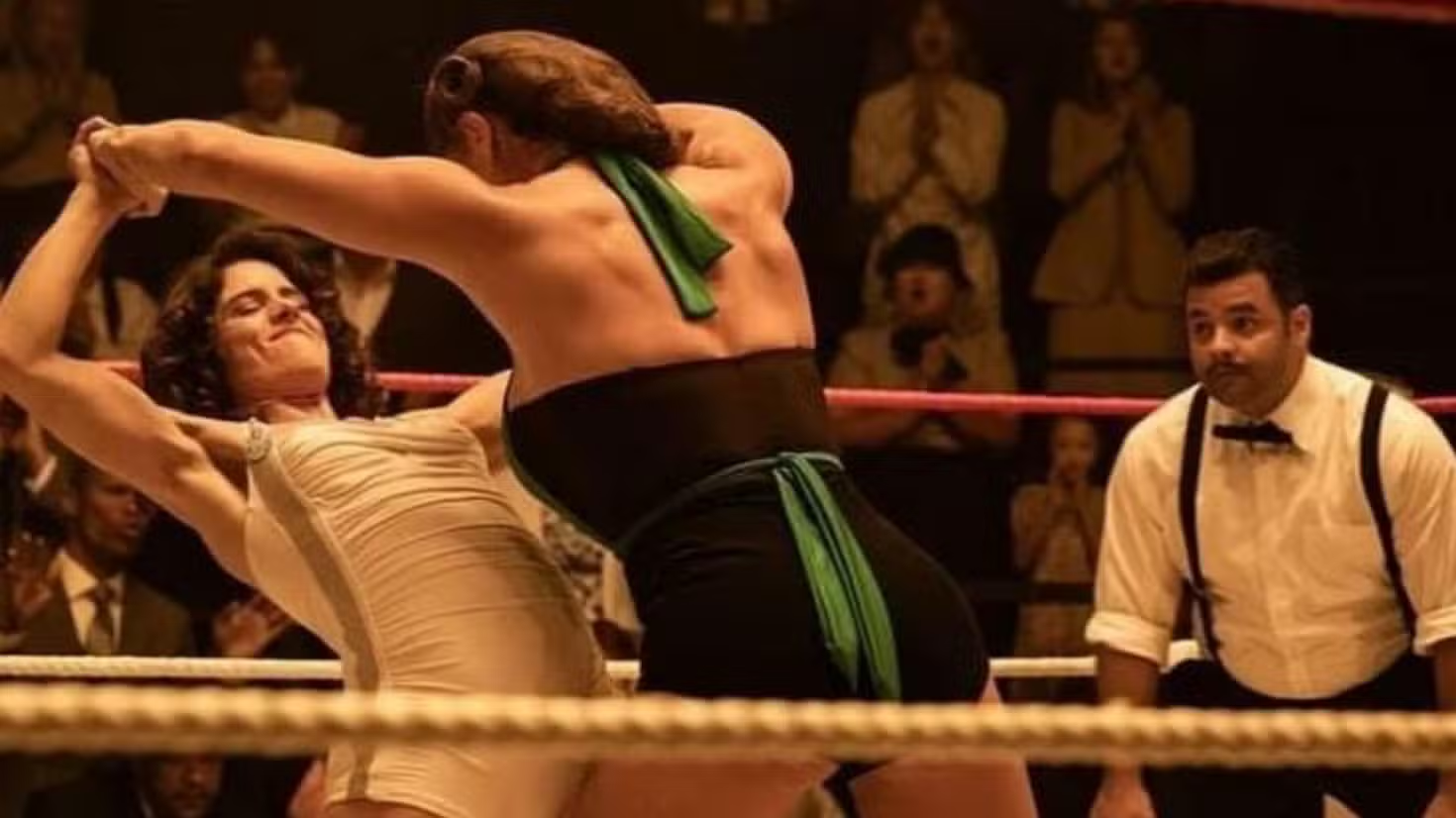
“Queen of the Ring” is out to hook viewers right from the start by opening with the climatic 1954 match between Mildred and the formidable June Byers (played by former NWA World’s Women’s Champion, Kamille) in Atlanta, Georgia. Avildsen bookends the movie with this intense match while flashing back to a more chronological approach to Mildred’s story, who is nicknamed the “Kansas Cyclone” and “Millie Muscles.” Right away, it’s easy to get on board with the storyline, not for the formulaic screenplay but due to the charming vibrancy of Emily Bett Rickards as Mildred Burke. Mostly known for playing Felicity Smoak in The CW’s Arrowverse shows, Rickard carries Avildsen’s movie with as much heart and determination as the character she portrays.
As Mildred, Rickards serves as the audience surrogate as the ambitious dreamer learns her way in the ring, getting familiar with terms like “heels” (villains) and “babyfaces” (heroes) while sharpening her showmanship tactics. These early scenes lay the groundwork for the birth of burgeoning lady wrestlers, eventually seeing black women wrestlers join the fold. But about halfway into the movie, the transitional editing makes the rest of the movie feel like a series of segments rather than an organic story. While Avildsen (the son of “Rocky” director, John Avildsen) shows the physical and emotional demands of wrestling, the financial draw and struggles are also shown, providing a well-rounded view of the state of pro-wrestling before the popularity of television in America.
Despite the movie supposedly being about Mildred, there’s an odd decision to give almost as much screen time to the Billy Wolfe character. It’s as if an Ike and Tina story is being forced on us. Also odd is the awkward and unexplored attraction that G. Bill has towards Mildred, his stepmother. With all the characters in “Queen of the Ring”, it’s a little crowded to try to shoehorn a forbidden romance into the picture, which already feels overlong. At least Rickards grounds it all, remaining the main reason to follow the story of Mildred Burke.
RATING: **1/2


