TWO WOMEN (2025) review

written by: Catherine Léger
produced by: Catherine Léger and Martin Paul-Hus
directed by: Chloé Robichaud
rated: not rated
runtime: 100 min.
U.S. release date: May 15, 2026
Two women from Quebec, screenwriter Catherine Léger and director Chloé Robichaud, got together and decided to remake the 1970 sex farce “Two Women in Gold (Deux femmes en or),” by Canadian filmmaker Claude Fournier, about two unfulfilled housewives in suburban Quebec. While not an initial hit with critics, it became one of the most commercially successful movies to come out of Quebec at the time. Such a subject was fully embraced during the “sexual revolution” of the 70s, popularizing unrestrained sexuality and marking a significant cultural shift towards open dialogue, liberation, and experimentation. So, the question that comes to mind is, will a modern take on the subject offer anything different or new? Well, yes and no, because the more things change, the more they stay the same.
First, a preface: A quick Google search tells us the following: approximately 15% to 20% of married couples in North America are in sexless marriages. Research indicates that about 7% of married adults have not had sex in the past year, while 4% to 13.5% haven’t had sex in the past five years. A “sexless marriage” is commonly defined as having sexual intimacy less than 10 times a year. So, if you’re a North American who can relate to any of those findings, take some solace in knowing you’re not alone.
What many married couples are experiencing now is different from where so many couples were at in the 1950’s, where words like “duty” superseded “pleasure” when it comes to bedroom activity, at least in the U.S. Nowadays, the lack of sex in a marriage is the result of a handful of factors, such as high-stress lifestyles, emotional disconnection, and the demands of parenting. Some couples pull out their calendars and schedule sex, which doesn’t feel very personal and certainly not spontaneous. It’s nothing new that so often the rationale for a zero-sum libido is attributed to: exhaustion, lingering resentment, health challenges, and mismatched desire, which leads at least half of the couple to simply give up.
What exactly does this have to do with “Two Women,” though? Well, the story revolves around Violette (Karine Gonthier-Hyndman) and Florence (Laurence Leboeuf), who live in adjacent apartments in Montreal. Both fortysomething women have one child; Violette has a teen, and Florence has a child starting daycare, and both are in sexless relationships. It’s not their choice, mind you, since their husbands seem oddly and unusually disinterested – as in not even remotely interested. That’s a subject that’s discussed, but never truly explored by Léger and Robichaud.
Violette’s husband Benoit (Félix Moati) is cheating on her with Eli (Juliette Gariépy) during “business trips”, while she spends all day breastfeeding and looking after her young daughter. Next door, Florence is feeling ignored, while her husband, David (Mani Soleymanlou), is more concerned with whether or not she’s still taking her prescribed antidepressant meds. Right away, it’s clear that both marriages are lacking in clear communication and that their respective sex lives have been put on the back burner or altogether ignored for some time.

The walls of the apartments they share are paper-thin, and when Violette hears what sounds like cawing crows, she wonders if it’s moaning from next door. She has Florence over and, indirectly, asks her whether Violette is the source of the noise and whether she’s getting off on being an exhibitionist. Is she just hearing things or hearing what she’d like to hear?
Florence denies the claims, and we know this to be true considering what little we’ve seen of her home life so far, but when she returns home, she decides to make a few changes. The first thing she does is get off her antidepressant meds and try to embrace a more adventurous approach to life. Her first bold step is to flash the phone repairman nearby, who is at the same level as her bedroom window. Soon enough, she is busting pipes just to receive a visit from a plumber that she can have sex with. Her personality perks up, and she tells Violette that monogamy is an invention that only benefits men, which inspires Violette to stop breastfeeding and call an exterminator after a sudden case of hamster droppings in her condo. Soon enough, the two women are getting unsuspecting gentlemen callers while their husbands remain clueless.

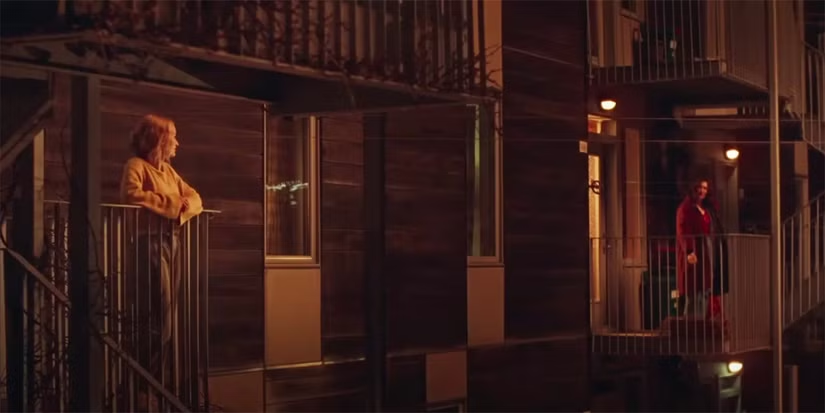
Sex with the visiting handyman or deliveryman is the oldest trope, but the cheeky and liberating manner that Léger and Robichaud present these afternoon delight trysts is quite funny and definitely sexy. Throughout the film, the condo complex where they live also serves as something of a character, perhaps in homage to Hitchcock’s “Rear Window”, which had its own take on voyeurism. Robichaud uses her extra-wide-screen frame to zoom out on the building so each woman looks minuscule against the larger wooden structure, just tiny little details in its complex world.
Both Gonthier-Hyndman and Leboeuf are fully invested as Florence and Violette, respectively, as they show their characters rediscovering their bodies and taking over their sex life with confidence and poise. Both actors hold their own in the film as they play off each other. Gonthier-Hyndman is playful and funny, embodying a kind of wildness that makes her magnetic on screen. Labeouf plays Violette with gentleness and empathy; when she finally indulges in infidelity, it’s hard not to cheer her on rather than chastise her. While it’s refreshing to see two fortysomething women turn things around in their trapped marriages, “Two Women” doesn’t offer a solution to the intimacy problems in their marriages. The movie doesn’t necessarily have to, but the two characters eventually have to come down from their sex high and, if they want to, invest that same energy in coming to some kind of realization about the person they married and have a kid with. It doesn’t seem like either of them wants to leave their husbands, and at least one couple shows the beginning signs of healthy communication.
Still, as the film nears its third act, it still feels like there’s potential to delve deeper into these relationship issues. There’s also an undeniable lull at times, where the film’s pacing feels uneven, especially as it rushes to its conclusion. Ultimately, “Two Women” boasts two strong performances, and while the film doesn’t offer more depth to their characters, they’re still a hoot to hang out with.

RATING: **1/2


