YOU CAN SEE EVERYTHING (2026) review

produced by: Maggie Ambrose, Tatiana Bears, Jack Davis, Nathan Fielder, Lance Oppenheim
directed by: Nathan Fielder and Lance Oppenheim
rated: R (for language and some graphic nudity)
runtime: 175 min.
U.S. release date: October 16, 2026
“fyi you can totally see everything”
I abhor micro-analysis of a film’s title, but it’s imperative here for “You Can See Everything.” The word “Can” does all the heavy metaphorical lifting. Anyone obsessed with grammar (or anyone with a real peach of a middle school English teacher) would happily tell you that “can” indicates ability. So what Elizabeth Holmes tells Nathan Fielder via text in the film, and what she and co-director Lance Oppenheim tell the audience, is that the potential to see everything does indeed exist in some way, shape, or form.
In 2023, little more than a month before reporting to prison for (what was supposed to be) an eleven-year sentence, former Theranos founder Elizabeth Holmes and her partner Billy Evans decided to invite Fielder and Oppenheim—with the backing of A24—to document their final month together as a family with their two small children (one of whom was born weeks before cameras started rolling).
I know a lot of folks know Fielder and his prior work on Comedy Central’s “Nathan For You,” but the show’s premise was him pitching comedically terrible plans to help struggling small businesses. This often led Fielder down tangents, sometimes abandoning the business owner altogether, as in his infamous “Dumb Starbucks” episode.

The final episode of his show was a feature-length endeavor titled “Finding Frances,” where Fielder and a Bill Gates impersonator traverse the country in an attempt to find the impersonator’s proverbial “one that got away.” These obsessions further expanded into his fascinating HBO series “The Rehearsal,” where he helps people prepare for big moments by recreating the circumstances and letting them rehearse the moment over and over to perfect it before having the conversation in real life.
I give you all this context to say he may seem like a baffling choice to document the couple’s final days as they try to relaunch her business plan. Evans tries to spin Fielder’s hiring as him being a kindred neurodivergent spirit to Holmes, but Fielder’s well-known brand of mischievous documentary filmmaking should’ve been a bright red flag. I’m not sure if they viewed Fielder as someone they could control enough to portray them in a positive light, but that certainly didn’t pan out.
It’s also interesting that Oppenheim himself explored similar territory in last month’s “Primetime.” Has reality television corrupted the documentary form, making the truth increasingly elusive, or did it just reveal that documentary was never reality to begin with? Oppenheim’s presence feels like a logical extension of his work on Primetime; how do we recover the truth once the circus leaves town?
All of the film’s advertising centers on the first half of the nearly three-hour endeavor, and I’m not going to say much more about the second half except that, if you are familiar with Nathan Fielder’s work, he’s up to his old tricks. The film’s second half embraces Fielder’s obsession with reality and the ability endless money and resources give him to recreate any given reality. But as he learned on “The Rehearsal”, the audience will always be left with the same question: whose reality is being presented?
Memory is faulty, and trying to recreate reality based solely on the recollection of one or two people will never accurately depict what actually happened. Nathan Fielder can get awfully close to reality by meticulously reconstructing the locations and circumstances down to the last detail, but it’s still his version of events within that framework.
A particularly fascinating scene shows Fielder trying to recall something Holmes said to him, and he has to decide whether the final word in her sentence was “it” or “something.” The quote he decides to go with is “I know he was talking to you about something,” but replace “something” with “it,” and the entire context of their conversation shifts. This is where the obsession lies in the back half of “You Can See Everything”, and frankly, in most of Fielder’s work.
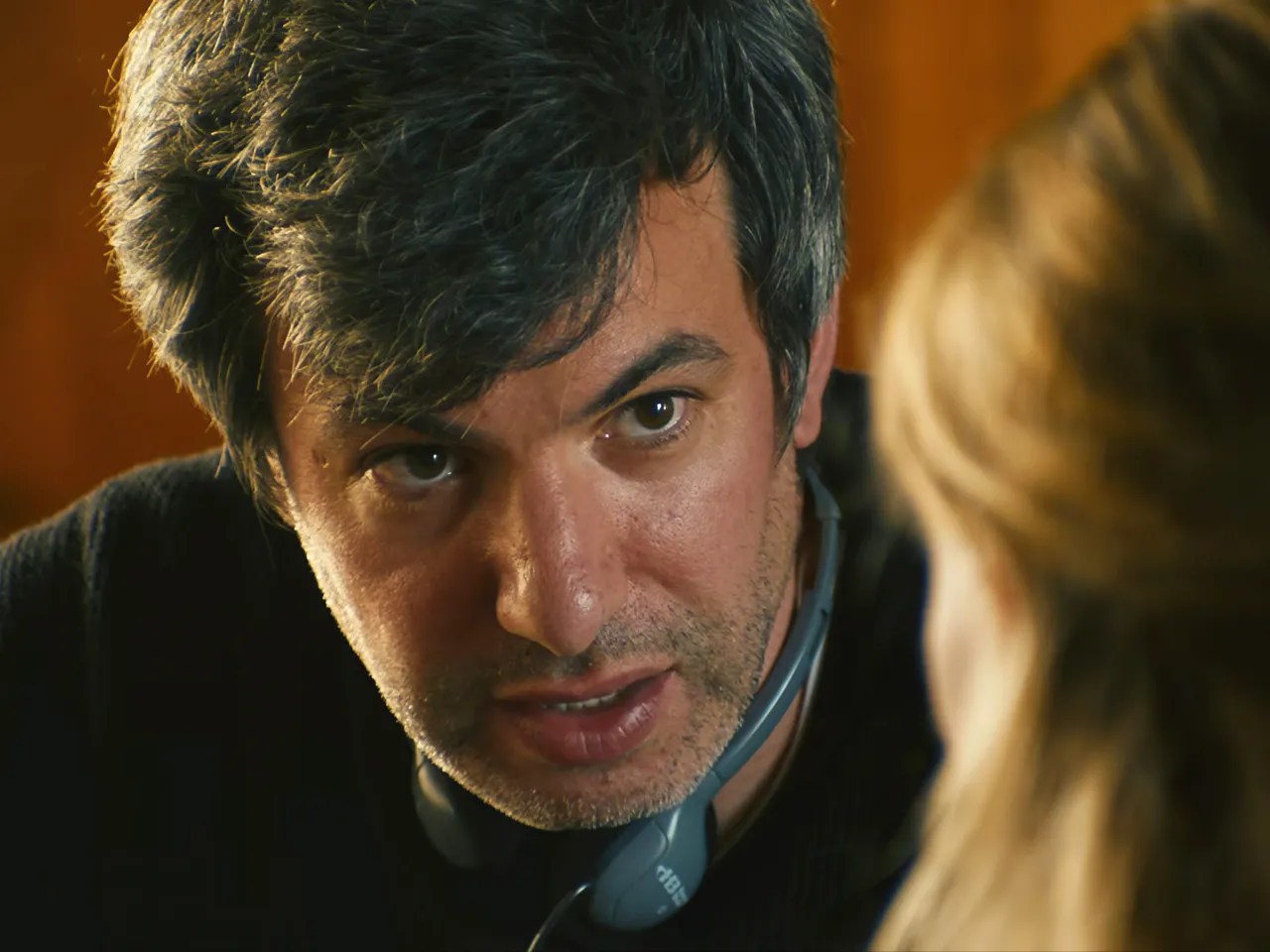
In one of the film’s most agonizingly uncomfortable scenes, Fielder shows Holmes and Evans the famous “Who’s on First” routine originated by Abbott and Costello, in an attempt to further elucidate the fact that words have multiple meanings and a statement like “Who’s on First” is both a question and its answer. I won’t say much more about this scene, but Holmes’s and Evans’s separate, distinct reactions to the bit speak volumes about the couple’s relationship.
Holmes herself leans into an obsession with words early on as she and Evans insist that a New York Times reporter misquoted her. Focusing on Amanda Seyfried’s portrayal of Holmes in the Hulu series “The Dropout”—which Holmes, Evans, and Fielder watch on the couple’s bed at one point—Holmes told the reporter that Seyfried wasn’t playing her; she was playing a character. Their obsession lies in whether Holmes said it was a character that “I created,” as printed, or “they created,” as Holmes recalls it.
This points toward the major contradiction in Holmes’ standard posture throughout the film, and even her life. She seems to willingly cede control in certain areas to protect her self-image. Her driving factor in business is to perpetually play the genial genius while her business and romantic partners play hardball behind the scenes. Does that position serve her or her image well? I’ll just say that it’s hard to sway public opinion on someone like Elizabeth Holmes.
I will always champion the idea that words matter, words have meanings, those meanings have deeper roots, and much of the language we use in interpersonal conversations is inherently flawed. Finally, a movie like “You Can See Everything” helps illuminate that point. Endless arguments can be had over individual words in sentences from conversations had years earlier. As Robert Evans famously said, “There are three sides to every story: your side, my side, and the truth. And no one is lying. Memories shared serve each differently.”
What makes “You Can See Everything” such a rich, fertile film for discussion is that pulling on any one of the film’s dozens of threads can raise more questions about the motives of those involved. It hasn’t been 24 hours since I first saw it, and I’m already thinking about other conversations, other looks, other words. This one’s gonna stick in your brain for a good long while. Find someone to chat about it with; you’ll have plenty to talk about, least of all whether seeing everything was ever a realistic possibility.

RATING: ****


