PETER ASHER: EVERYWHERE MAN (2026) review

produced by: Daniel Geller and Dayna Goldfine
directed by: Daniel Geller and Dayna Goldfine
rated: not rated
runtime: 118 min.
U.S. release date: June 16, 2026 (limited) and June 26, 2026 (wide)
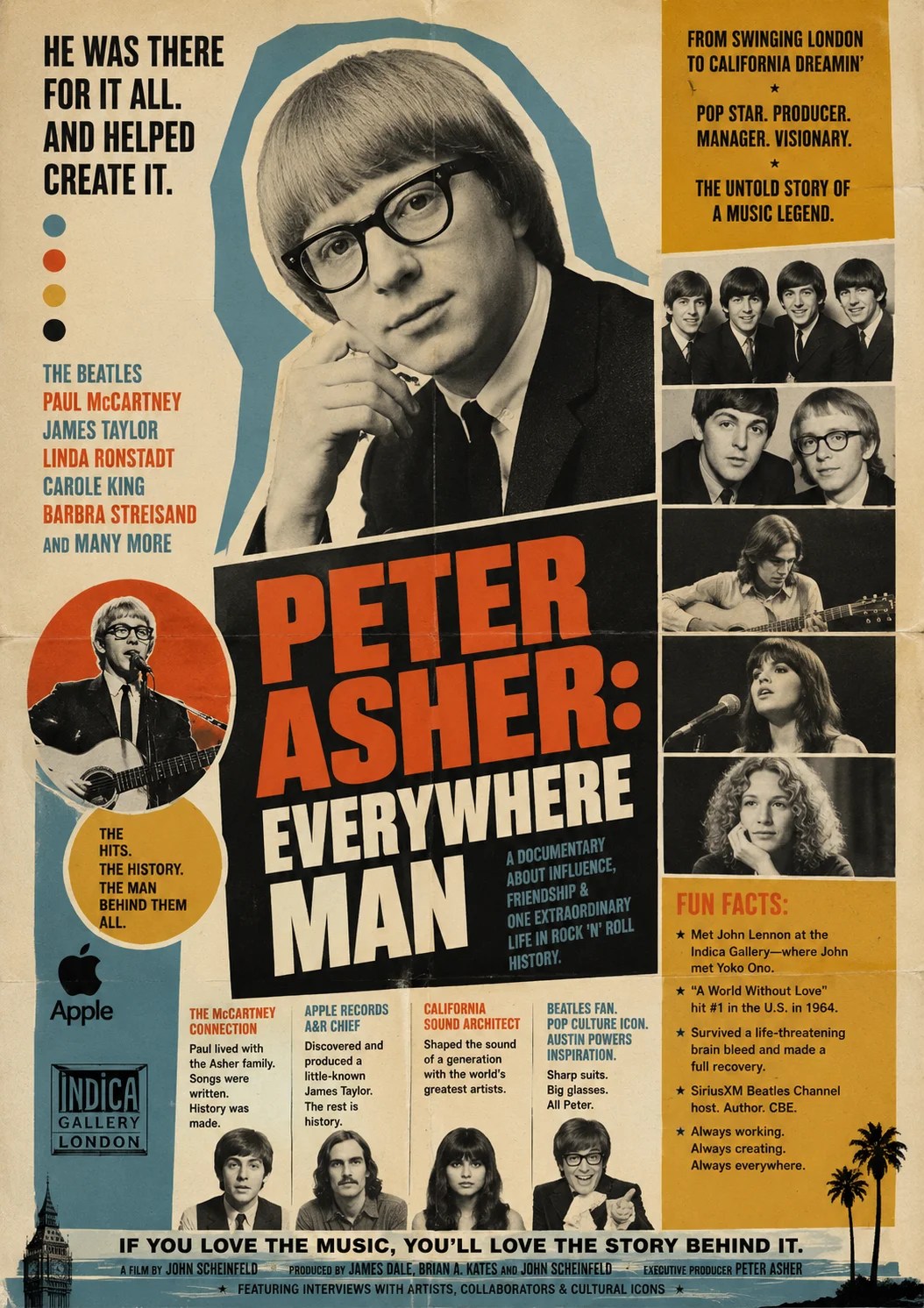
At the cold open of the documentary “Peter Asher: Everywhere Man,” there’s a rapid-fire montage of everyone from Paul McCartney to Robin Williams stating his name from a podium at some awards telecast. It’s at least a couple of dozen presenters or winners, acknowledging their thanks and appreciation to Peter Asher. But why does that name sound familiar? Only those with an in-depth knowledge of the British Invasion, influential record producers, and Austin Powers will know who Peter Asher is. This documentary, which was co-produced and directed by Daniel Geller and Dayna Goldfine, sets out to change that.
Peter Asher first became popular as one-half of the 1960s British pop duo, Peter and Gordon, with Gordon Waller, who recorded several songs written by Paul McCartney. That came about because Peter’s sister, Jane, was dating McCartney for the better part of the decade (1963–1968), and the two became fast friends, bonding over music and songwriting. Some of those songs, “A World Without Love”, “Nobody I Know”, and “I Don’t Want to See You Again”, became hits in the UK and eventually the US. The documentary touches on how Peter and Gordon met while attending Westminster School, and how they liked the way their voices sounded together, so they began performing in cafes and eventually caught the attention of EMI Records.
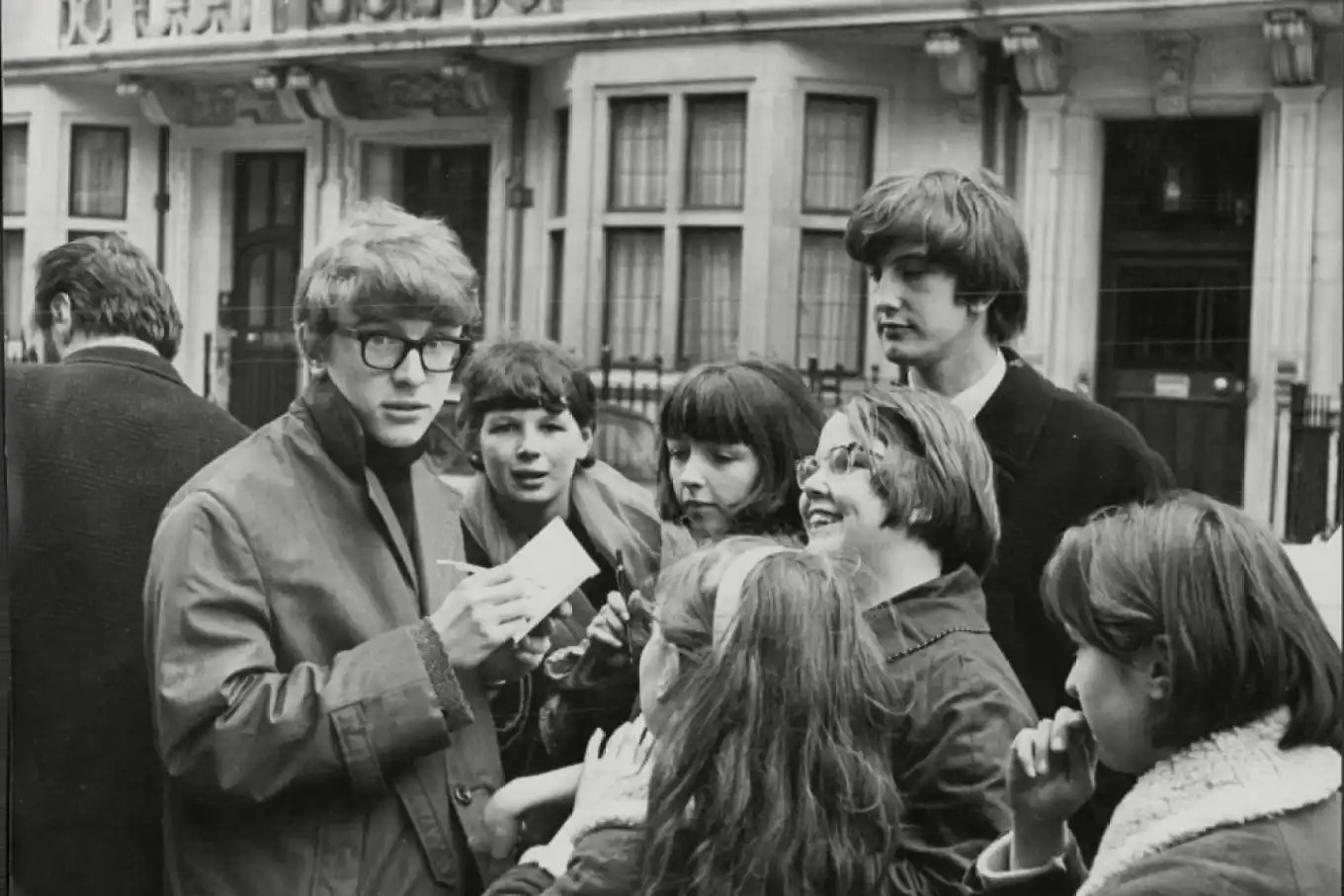
For die-hard Beatles fans, McCartney’s association with Peter and his sister is probably well known, but it was a surprise to me that McCartney would allow his songs (credited to Lennon–McCartney) to be used by other musicians. We also learn that while Paul was dating Jane, the Asher family became something of a second family for him, and he’d often come over just to hang out with them.
Geller and Goldfine include Asher himself as sort of the host of “Everywhere Man”, by incorporating sequential clips from one of his recent autobiographical stage shows at the Bimbo’s 365 Club in San Francisco. He waxes poetic about his life (upbringing, childhood, career, etc) surrounded by a full band, and by including these clips, the documentary becomes more personal, like a memoir, with a sprinkling of the requisite talking heads. At one point, Asher tells the audience that he recalls John Lennon often coming over to hang out with Paul and work on songs. They asked Peter to come down to the basement and listen in, and he shares how his were the first ears to hear “I Want to Hold Your Hand”. That’s insane.
When Peter was a young boy, he and his two sisters all got into acting, with publicists promoting them as the red-headed trio. Peter and Jane had brief roles in a British television adaptation of “The Adventures of Robin Hood”, and Peter also appeared in the British war drama “The Planter’s Wife”. Once he was enrolled at Westminster, he became more interested in music. While he and Gordon performed other people’s songs, Peter started to show an interest in how songs and records were made. That interest came in handy, considering Gordon was more interested in the “sex and drugs” of it all, rather than the creative process of the music.
In 1965, Asher would find himself stepping into a new career. He teamed up with artist/gallerist John Dunbar and writer Barry Miles, and opened a bookstore and avant-garde gallery, both called Indica (the scientific term for cannabis), on Carnaby Street. This location in the Soho district is noted as the epicenter for the “Swinging London” culture revolution of the 60s, and the birthplace of urban youth fashion and subcultures like the Mods. It was at Indica where Dunbar introduced exhibiting artist Yoko Ono to John Lennon. The same year that Indica debuted, Dunbar and Marianne Faithfull were married, with Asher as Dunbar’s best man. A year earlier, Asher had introduced Faithfull to the Rolling Stones, and Mick Jagger and Keith Richards wrote “As Tears Go By” with her in mind. It became a hit song for both Faithfull and the Stones, and she and Dunbar divorced when she started seeing Jagger. They were romantically involved from 1966 to 1970, but it all started with Asher introducing Faithfull to the Stones at a party in March 1964.
Around the time the Indica scene was dying out, and Peter and Gordon disbanded in 1968, Asher began taking on the role of record producer. Asher found perhaps his true calling when former Manfred Mann singer Paul Jones asked him to produce his first solo album. That worked out so well that McCartney hired him as head of A&R at Apple Records, the company the Beatles launched in April 1968. He signed a then-unknown James Taylor to the label after being impressed by his singing and songwriting. McCartney and George Harrison were equally impressed. Asher produced Taylor’s first album, which wound up being a bit overproduced and didn’t quite capture Taylor’s style.

When Apple Records began to fold, Peter followed Taylor back to the States, determined to show the world the artist’s potential. With McCartney’s encouragement, Asher became Taylor’s producer. The next album they made together was “Sweet Baby James”, and it became a landmark album and an early success in Taylor’s career. It was recorded at Sunset Sound in Los Angeles in 1969, and at the time Taylor was flat broke and sleeping on guitarist Danny “Kootch” Kortchmeyer’s couch. Besides the album’s chart-topping hits like “Fire and Rain” and “Country Road”, it was also the album that Asher introduced Taylor to Carole King, and one of the first to list all the musicians who participated in the recording on the back cover. “Everywhere Man” includes recent and archival talking-head moments from this time, with Taylor, King, and Kootch reflecting on those days and the impact Asher had on them.
During moments when the documentary returns to the stage show, Asher, now in his early eighties, with his sparse red hair and tortoise-shell glasses, describes all of this in a matter-of-fact, menschy manner. He was and remains one of the squarest stars in pop history — a polite, nerdish Englishman who would, surprisingly, be described as shy. Yet his eye for talent and ear for music, especially burgeoning artists, was uncanny.
How Asher came to be Linda Ronstadt’s manager is an interesting story involving Taylor’s sister, Kate Taylor, herself a singer/songwriter with whom Asher started working. When Kate realized that the music business wasn’t for her, she suggested Asher manage Ronstadt. That’s when Asher did some of his greatest producing, starting with Ronstadt’s 1974 album “Heart Like a Wheel”, and working with both Taylor and Ronstadt in the 70s and 80s, Asher produced a long string of multi-platinum albums. In 1977, Asher appeared on the cover of Rolling Stone magazine, along with Taylor and Ronstadt, marking the first time a record producer had made it on the cover.
The documentary also touches on his personal life, showing how his career affected his dating and marriage. His first wife was Elizabeth “Betsy” Doster, an American music publicist for the Rolling Stones, and they married in London in 1970. Their marriage lasted until the late 70s, when the couple quietly divorced and eventually moved on, marrying art collector Wendy Worth in 1983, with whom he remains happily married.
Most of what is told in “Everywhere Man,” I wasn’t aware of, and my bet is that most viewers will be in the same boat. I had no idea he worked with Diana Ross and Barbara Streisand, and I definitely didn’t know that two of my favorite 10,000 Maniacs albums, “In My Tribe” and “Blind Man’s Zoo”, were produced by Asher. Natalie Merchant is included here and chimes in to share her experience with Asher.
The documentary certainly paints Asher as the titular “Everywhere Man”, despite not being the loudest or most well-known person in the room. There have been other documentaries about music producers – granted, not a lot – but this is the first one I could recall where the subject was a child actor, a pop star, an award-winning music producer, and a manager. Asher has influenced many people in his life, and it’s fascinating to see who is here and how involved he is in telling his story.
Oh, and if you’re curious about his rumored influence on Austin Powers, then stay for the end credits.

RATING: ***