THE HISTORY OF CONCRETE (2026) review

produced by: Clark Filio, Shirel Kozak, and Allie Viti
directed by: John Wilson
rated: not rated
runtime: 100 min.
U.S. release date: September 18, 2026
Who would’ve thought that we’d have two documentaries about concrete within just two years? In August 2025, there was Viktor Kossakovsky’s “Architecton”, which explored the history of concrete guided by legendary architect and designer Michele De Lucchi. Now there’s a documentary called “The History of Concrete” from director John Wilson, an American documentarian known for HBO’s “How To with John Wilson”, the quirky comedy docu-series that lasted for three seasons from 2020-2023. Wilson is drawn to what many consider mundane, bringing attention to things we typically tune out and people we overlook. Using clever, often wryly humorous shot selections, uncanny editing, and his own deadpan narration, Wilson keeps his subject matter funny, surprising, and entertaining.
If you’re familiar with Wilson and enjoy his work, “The History of Concrete” will likely be your jam. If not, your enjoyment will depend on what you find funny.

His feature-length debut feels like one long episode of the New York City-based “How To”; in that, like those episodes, there’s a subject in the title, but Wilson, being the curious humanist that he is (and presumably a touch of ADHD), often spirals off topic, sometimes finding something surprising and/or comical. So don’t expect an in-depth, exhaustive look at the origins of concrete; that would likely take us all the way back to Israel in 7000 B.C. While water, sand, and gravel are the typical main ingredients, how they are formed into the most popular composite material and what they are used for has varied over thousands of years.
Wilson’s documentary is as much about himself as it is about the titular building material. At the start, “The History of Concrete,” the director is in a dark place. Set about four years ago when his HBO supposedly came to an amicable end, we find Wilson bemoaning how jobs have been hard to come by since, sharing how, “The space between projects is hard”. He also shares how his fame has its price, as he learns that his voice was stolen by A.I. and hilariously used to sell certain products, such as a gutter repair service company. He seems both flattered and flummoxed by it all. Wilson’s signature second-person narration takes some getting used to, as does his nasal voice.
Looking to pass the time, Wilson heads back to the Big Apple for inspiration and initially lands an educational opportunity with the WGA. He attends a class on writing tips for Hallmark Channel productions, where an enthusiastic instructor humorously points out the common recycled formulas in each movie (especially the holiday subgenre) for the popular cable channel. But, what how does that tie-in with concrete?
What begins as an exploration of Wilson getting his groove back soon veers all over the place as his proclivities take over, starting with concrete and splintering off into a dozen or so different directions. Wilson isn’t necessarily going to use what he learned in that writing class for his upcoming project, but he’s also not going to rule it out. One particular problem he finds is financial backers for his latest endeavor, which is relatable to any independent filmmaker or documentarian.
While most of the film takes place in New York City, it also stops early on in Italy, where Wilson ponders how ancient concrete remains prominent in Rome. To find answers, he interviews local Italians he meets on the street, but most know very little about the old structures and why they still stand. Their ignorance matches Wilson’s.
Upon returning to New York City, Wilson finds concrete used in various ways. He questions how long certain concrete lasts, what tarnishes it, or what makes it deteriorate. At one point, he meets street workers whose sole task is to remove dried-up gum on sidewalks that has turned into sticky trash. These “Gum Busters” that Wilsom meets are also quite enthusiastic, the kind of people that we’d typically see right through, but here they become intriguing characters in this engaging journey.
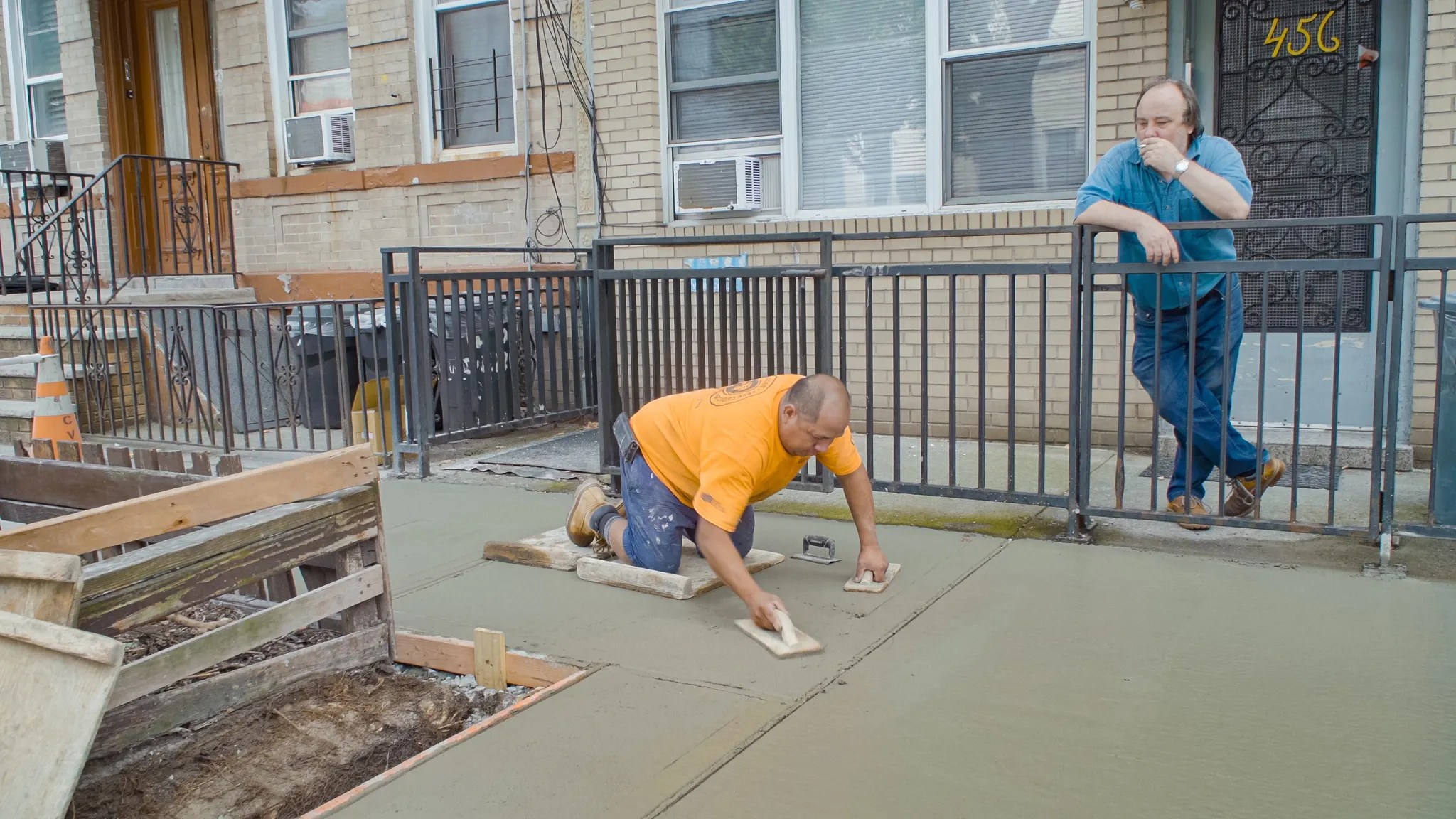
Soon enough, inspiration strikes from his shared responsibilities as a landlord in the Ridgewood neighborhood in Queens. He’s dealing with foundation issues in the old property (which have turned into financial issues), revealing his complete ignorance when it comes to DIY concrete repairs. Wilson often delivers stumbling narration and scattered focus, chasing tangents and ideas instead of staying on the premise of the picture, which doesn’t factor into the finished film. Instead, he tries to charm with his winding ways, which take him to a few strange places, including the first concrete street in America, located in Ohio.

Wilson stays on the movie in “The History of Concrete”, even finding himself attending a concrete convention, where the industry shows off its innovations and gadgets. Yes, there’s a convention for everything. This professional setting lets the documentarian ask questions, as he’s not interested in humiliation but in the subculture. Wilson certainly doesn’t remain in one place for too long, showing interest in the world of tattoo preservation, where art is peeled off dead bodies for home or office display. Not too creepy. In Los Angeles, Wilson shares his experiences at the Emmy Awards and a private dinner celebrating Kim Kardashian. That’s where he meets a concrete salesman who’s also an actor and ends up following him to an acting job, drawn more by the challenges of low-budget production.
At one point, the film examines the sand-production crisis and environmental concerns around concrete recycling. However, more time is spent trying to reconnect with the fading Hallmark-structure concept, watching as Wilson befriends Jack, an NYC musician who can give the documentary some star power. Jack’s story monopolizes the final act of “The History of Concrete,” as he faces professional and personal woes, and he’s meant to provide the picture’s “heart.” The problem is he’s not that charismatic or interesting a character. Nevertheless, Wilson loves including Jack, adding another distraction that helps shape his idiosyncratic approach to moviemaking, mixing his personal life and professional woes into an intermittently fascinating and frustrating viewing experience.
Again, what does all this have to do with concrete? Well, not much, but you either get used to that, or you don’t. As mentioned, “The History of Concrete” is perhaps best enjoyed by fans of his HBO show. I’ve never seen an episode of his show, so I have no idea what to expect. It took a bit, but I eventually got used to his overall quirky style and his lack of segues as his trademark. “The History of Concrete” seems built strictly for fans of “How To with John Wilson,” following his television presence and lack of segues.
The documentary’s title winds up serving as a template or starting point, eventually and inevitably providing nothing concrete. After being well-received at Sundance earlier this year, “The History of Concrete” now comes to select theaters thanks to Magnolia Pictures.
Fowli

RATING: **1/2

