THE HUNGER GAMES: SUNRISE ON THE REAPING (2026) review

written by: Billy Ray and Michael Lesslie (screenplay) and Suzanne Collins (story)
produced by: Nina Jacobson, Brad Simpson and Francis Lawrence
directed by: Francis Lawrence
rated: PG-13 (for strong violence, bloody images, disturbing material, some smoking and teen drinking)
runtime: 158 min.
U.S. release date: November 20, 2026
“The Hunger Games: Sunrise on the Reaping” marks the sixth entry in The Hunger Games franchise and the fourth directed by Francis Lawrence, after starting with 2015’s “The Hunger Games: Catching Fire”, and I haven’t shown much interest in the franchise since. That’s the year the Katniss Everdeen saga ended with the fourth entry, “The Hunger Games: Mockingjay – Part 2”; and Jennifer Lawrence became an icon and solidified her stardom with the role. Lionsgate Films had to capitalize on the material as much as possible, which is why the third book was turned into two movies and why a prequel, “The Hunger Games: The Ballad of Songbirds & Snakes”, was released three years ago. It was a surprise hit when it was released, which means a sequel to the prequel was inevitable. “Sunrise on the Reaping” takes place forty years later and tells another story from the early days of Panem. It’s a bigger offering that returns to familiar themes, reheats conflicts, and captures more survival panic, yet none of that makes it better or worthwhile unless you’re a die-hard fan of this particular IP.
Just as “Songbirds & Snakes” followed a young Coriolanus “Coryo” Snow, before he went on to become dictator, President Snow, “Sunrise on the Reaping” also follows a younger version of an established supporting character, Haymitch Abernathy, before he becomes the alcoholic mentor of the young contestants in the Games. An urban legend was created when Haymitch won the 50th Hunger Games, known as the Second Quarter Quell, and this story explores how he became the sole survivor at sixteen.

What made this particular round of Games special? One element that separated the 50th year from earlier years is that the Capitol doubled the number of tributes chosen from each district, from two to four (two of each gender). That means not only double the training, but double the number of district families torn apart, and double the bloodbath during the Games. It’s also set in a deadlier, more deceptive arena, filled with colorful, albeit poisonous, flora and fauna, toxic water, and deadly mutated wildlife. All of this builds interest across Panem and is apparently meant to draw viewers to this sequel/prequel.
Like Katniss, Haymitch Abernathy (Joseph Zada, trying hard to emulate a young Woody Harrelson) hails from District 12, the smallest and poorest location, located in Appalachia, known for mining the coal that powers much of Panem’s industry. This is where Haymitch lives with his widowed mother, Willamae (Kara Tointon), and younger brother, Sid (Smylie Bradwell), and where he has a secret relationship with Lenore Dove Baird (Whitney Peak), who lives nearby with her uncle, Clerk Carmine (Jeffrey Hallman), both of whom are members of the Covey, a musical group that has settled in District 12.
On the morning of the annual reaping ceremony, everyone in District 12 has gathered to find out whose name will be selected as a tribute. Armed and masked Peacekeepers surround the anxious citizens as Capitol escort, Drusilla Sickle (Glenn Close, channeling Mrs. Ida Lowry from Terry Gilliam’s “Brazil”), the stretched-out face of the empire, is wheeled out to read the names she selects in her typically exaggerated manner. Wyatt Callow (Ben Wang), Louella McCoy (Molly McCann), Maysilee Donner (McKenna Grace), and Woodbine Chance (Serafin Mishiev) are called onto the stage, but when Chance is shot and killed as he tries to make a run for it, and, as expected, Haymitch’s name is called. All of this is captured on film by Plutarch Heavensbee (Jessie Plemons, who has almost the same amount of screen time that he had in “Digger”), a young cameraman working for the Capitol, who oversees the streaming of the Games and the events leading up to them, as well as footage that can be edited and deepfaked for pro-Capitol propaganda approval.

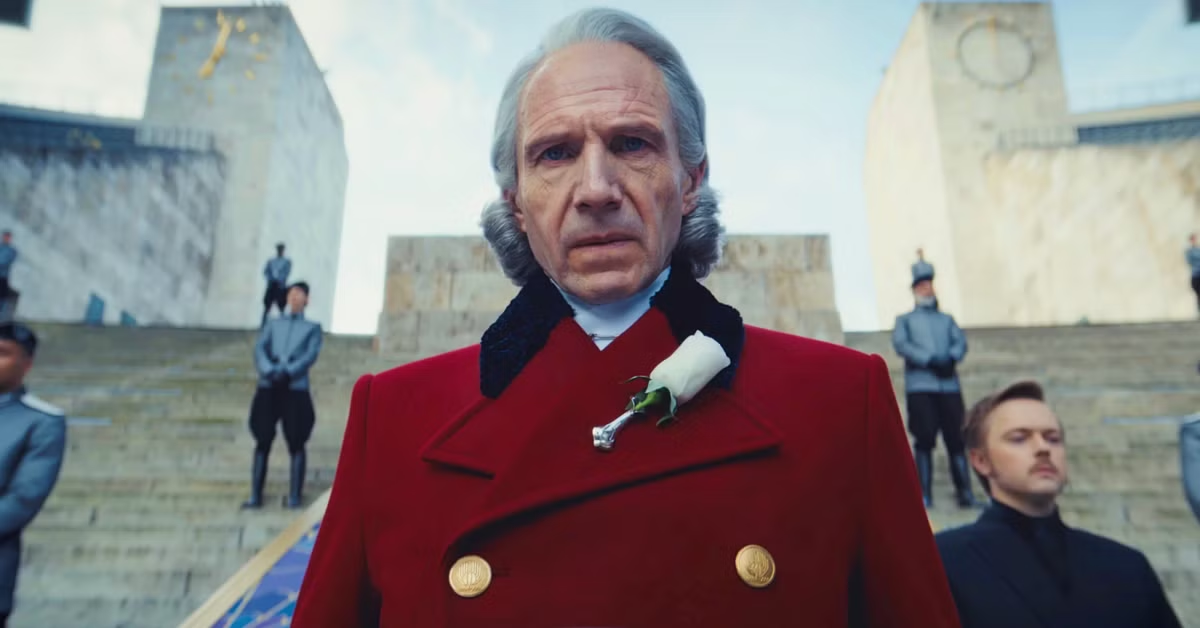
The quartet is skuttled off to the Capitol to begin preparation for the event, and Haymitch is thoroughly overwhelmed by the experience. They are thrust before the likes of T.V. host Caesar (Kieran Culkin, comfortably overacting here), stylist Effie (Elle Fanning), and mentors Wiress (Maya Hawke) and Mags (Lili Taylor), who hail from Districts 3 and 4, respectively. The last three have an internal fear and emptiness they do their best not to show, but it’s pretty clear they have some serious PTSD. Overseeing it all is President Snow (Ralph Fiennes, effortlessly walking through an emotionless role), who aims to ensure that Haymitch is killed during the Games. Despite the odds against him and the harsh reality of the inevitable fatalities around him, Haymitch sets out to survive a rigged system by finding a way to disrupt the Capitol’s plans and, hopefully, bring it all down.
Well, since we know “Sunrise on the Reaping” is a prequel and that the Capitol and President Snow are in the previous adaptation of the three Hunger Games books by Collins, the curious aspect of this movie is whether or not it can keep the audience engaged and riveted, considering how they know the future of many of these characters and that many of the new characters will likely die. For some reason, the movie moves at a glacial pace until about halfway through, when the Games begin. It feels like much of the pomp and preparation could’ve been trimmed in the first half, since it drags on and emphasizes what we already know. Once the event kicks into gear, the nervous young tributes are left to either join together or fend for themselves, and Haymitch must navigate through the pomp and preparation involving managing publicity and physical training, as he does his best to learn who he can get help from and who will likely be ready to kill him.
“Sunrise on the Reaping” is hard to watch, not because it’s violent – it actually could’ve been more violent considering the stakes and peril – but because it basically repeats what came before it, beat by beat. The biggest problem is that the movie suffers from the same issues that hamper other prequels, namely how hard it is to care about certain characters’ well-being when we’ve already seen their adult versions in the original story.
In “Sunrise on the Reaping,” Haymitch is told several times, in some variation, that he won’t survive the Games. That may be appropriate for the context of the story, from screenwriters Billy Ray and Michael Lesslie (who appear to stick faithfully to Collins’ 2025 novel), and for any viewer for whom this is their very first Hunger Games movie, it’s understandable how the weight of such an utterance can be felt, but for those of us who know that Woody Harrelson was in the previous movies as Haymitch Abernathy, it’s hard to get on board with Zada and all his crying, yelling, and snotty slobbering. Much of the storyline follows the same formula, but there’s not much more to it: there’s a reaping, competitors reflect on their mortality, and certain tributes try to form alliances and seek protection, all while attempting to stay alive.
One element that’s slightly different is how Haymitch fits into Capitol disruption, accepting information from others who oddly discuss a rebellion in the open, despite heavy surveillance throughout the buildings. Do they want to get caught? Tension builds during Haymitch’s face-off with President Snow (as great as Fiennes typically is, there isn’t much to the Snow role here), who senses where Haymitch’s true loyalty lies and makes him aware that he doesn’t have a chance. Again, we know that’s just not true.
When the Games eventually begin in the film, it feels very naturalistic, even in a vibrant, colorful digital realm. Some tributes are indeed killed by other competitors with weapons laid out for them, but because Lawrence, along with cinematographer Jo Willems and editor Mark Yoshikawa, cuts away from the brutality, the severity of the environment they’re in isn’t at a level it should be. At some point, nature is programmed to attack with clawing birds, biting butterflies, and savage squirrels attacking Haymitch and other tributes, and it becomes unintentionally silly and repetitive. Environmentally, the only difference here is an exploding volcano (also programmed), which looks cool at first, but its destructive impact should’ve been more devastating.
With most of the proposed suspense absent, “Sunrise on the Reaping” winds up feeling strange. How many of Haymitch’s near-death experiences are we supposed to be riveted by, knowing what we know, before we just check out? The movie’s lengthy runtime doesn’t offer the story or the audience anything new or surprising, so it becomes one of the more forgettable offerings in the franchise. Hopefully, this is it. I find it hard to believe anyone was wondering why and how adult Haymitch became an alcoholic, so I can’t see going back to the prequel to dig up more unsolicited backstories. The tacky, eye-rolling cameos at the end are a fitting coda for the whole saga.

RATING: **


