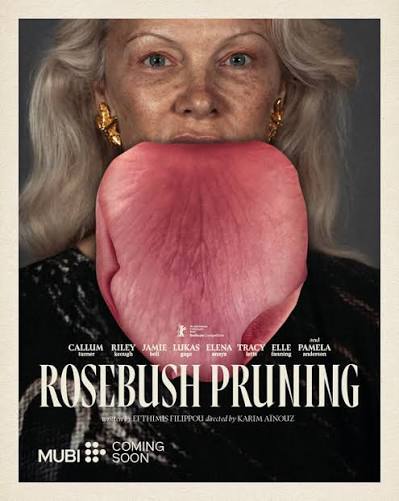
ROSEBUSH PRUNING (2026) review

written by: Efthimis Filippou
produced by: Michael Weber, Viola Fügen, Simone Gattoni, Annamaria Morelli, Andreas Wentz & Vladimir Zemtsov
directed by: Karim Aïnouz
rated: not rated
runtime: 95 min.
U.S. release date: July 24, 2026
One can certainly appreciate what “Rosebush Pruning” is doing, while also being completely flummoxed by how it goes about it. It’s not so much ambitious as it is audacious, and it revels in a provocative tone that resembles an amalgam of Olivier Assayas and Yorgos Lanthimos. Coincidentally, the screenplay is written by Efthimis Filippou, who wrote five of Lanthimos’s films, from “Dogtooth” to “Kinds of Kindness”, so he knows a few things about weird family dynamics, which is what is found here. While it has a similar cadence to those films, “Rosebush Pruning” finds Brazilian director Karim Aïnouz and Filippou loosely remaking an Italian satirical drama from 1965 called “Fists in the Pocket”, the feature debut from filmmaker Marco Bellocchio. Finally, someone decided to do what I’ve been saying for years…if you’re gonna remake a movie, remake one that hardly anyone knows.
The modern-day story revolves around an affluent family that moved from New York City to a sprawling modern estate in Catalonia, Spain, six years ago. Why did they move? The Mother (Pamela Anderson) was in love with Catalan architect/designer Antonio Gaudí and her adult children have an affinity for the avante garde designs of Balenciaga (think chunky sneakers and oversized apparel). However, Mother didn’t last long, since she was ripped apart by a pack of wolves near their oppulent home, leaving her family a robust inheritance to live off of. To get an idea how weird this family is, we see them take a sacrificial lamb to the site of her death, to honor The Mother’s memory and make sure the wolves are well fed. It winds up being a bizarre ritual that staves off the boredom of wealth, while also confirming how perverse this family is.

The four “kids” are left to take care of their blind, canktankerous, and judgemental Father (a hilarious Tracy Letts), but that doesn’t necessarily mean he’s in good hands. All of the kids are unsettlingly weird in their own way. The only one resembling any kind of normalcy is Jack (Jamie Bell), and he is secrectly desired by his epileptic brother, Robert (Lukas Gage), and his scheming sister, Anna (Riley Keough); and she is deeply jealous of Martha (Elle Fanning), Jack’s guitarist fiance. Indeed, this family is definitely a mess, and the more we know of them, the more we tune into the shock value tone Flilippou and Aïnouz are aiming for. There aren’t just hints at incest here, and despite outward appearances, no one in the family is “normal”.
The protagonist and narrator of “Rosebush Pruning” is Edward (Callum Turner), the other adult child, who often dreams of fleeing to Greece to spend time with George (Yorgos Stefanakos, “Poor Things” and “Kinds of Kindness”), an older doctor he met at a medical convention, but most of the time he dreams of flying shoes and handbags. Early on, he tells us that he likes to make up phony profound sayings that appear to reveal great truths but are actually utterly meaningless, such as, “A banana falls down, no matter. A melon falls down, it’s over,” and this is where the film’s title comes from, “People are roses. Families are rosebushes. Rosebushes need pruning.” Neither of those lines are very deep, but that last one is quite telling, and basically the film in a nutshell.
The perversity continues in ways that indicate that anything is possible. One thing is certain, no one can say there’s anything predictable here. As one shocking sequence follows another shocking sequence, the result is basically that nothing is off limits, and therefore: nothing is shocking. The whole endeavor is a lot, but I have to say I was impressed with how twisted and cruel it all is.
At times, it seems like “Rosebush Pruning” wants to try to contextualize or explain itself, as these characters and their madness. I didn’t always buy it, but it was a hoot to watch just how far the insanity would go.
Without a doubt, the film’s highlight is a lunch scene in which Bell’s Jack invites Fanning’s Martha over to the house to meet his family for the first time. Such situations are usually awkward and can be kind of uncomfortable, but it all goes “next level” here as the family has absolutely no qualms about showing how odd they are. At first, there’s uneasy giggles and ruthless stares, and then the blind Father asks Anna to describe Martha’s appearance in exhaustive detail. She starts by pointing out the obvious price gap between her Zara dress and the Bottega handbag Jack gifted her, and that right there would normally be uncomfortable. But, this isn’t a normal family or a normal movie. The Father takes it even further when he calmly asks his daughter to describe Martha’s breasts. The scene is fantastically performed by all, showcasing a baffling display of brazen and perverse awkwardness, but Fanning definitely stands out as someone new to this messed up family.
“Rosebush Prunng” has what could be perceived as statements or themes, but they’re about as deep as the stupid sayings that Turner’s Edward come up with. The lurid film is taking a stab at class and family, desire and freedom, as well as repression and money, but it’s far from any biting commentary. It may not have much of a point, but it does display a talented and game cast, with some of the most memorably strange and provocative scenes I’ll probably see all year.

RATING: **1/2