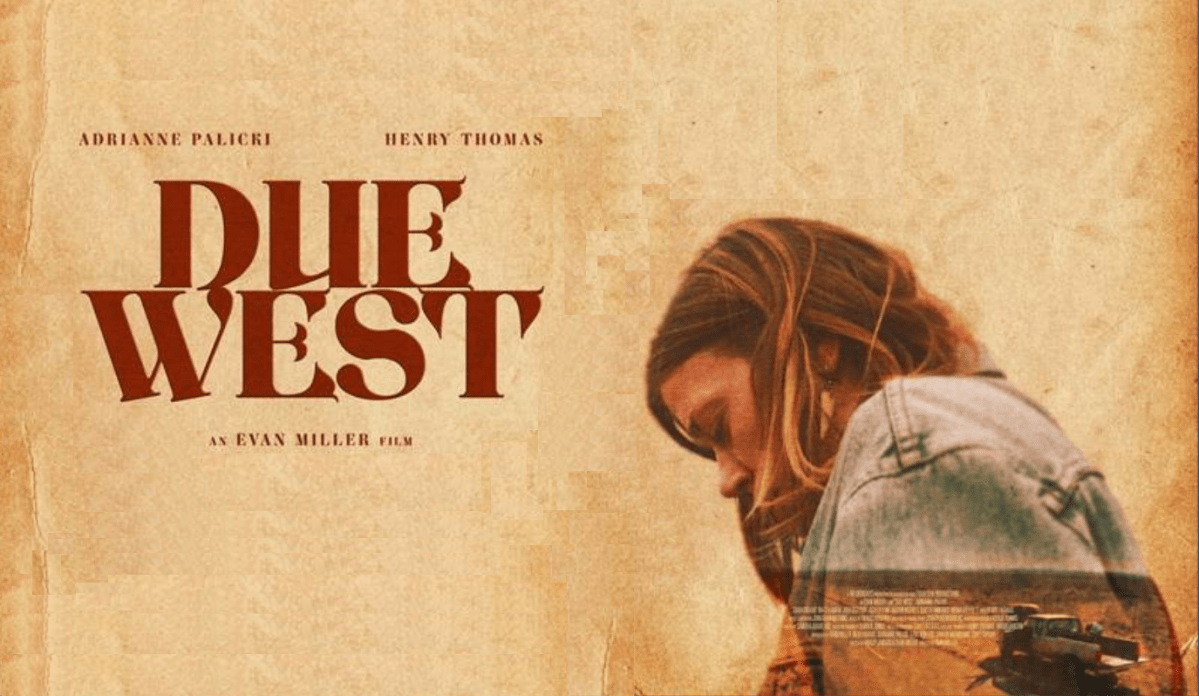
DUE WEST (2026) review

written by: Hardy Janson and Evan Miller
produced by: Emily Gipson, Beau Harris, Caitlin McFarland, Evan Miller, Adrianne Palicki, Ezra Venetos
directed by: Evan Miller
rated: not rated
runtime: 81 min.
U.S. release date: July 28, 2026 (VOD)
“I’ve never seen a woman so hysterical, and I’ve been married twice.”
As moviegoers, we’re sort of instinctually trained to avoid any movies that seem like they’re going to make us uncomfortable. Cinema has always been a great escapist art form, go to the movies and forget about your troubles for two hours, but it has also always been a vehicle for dealing with pressing social issues—and even some that aren’t so pressing. Therefore, it’s understandable that one might approach a film like “Due West” with a healthy dose of apprehension.
Adrianne Palicki’s unnamed lead character has to travel around 60 miles to Alpine, in Southwest Texas, to meet someone in order to obtain a prescription that is basically contraband in the state. When her car breaks down only ten miles into her trip, she must rely on the kindness of strangers to reach her destination, encountering a variety of people willing to help or exploit her along the way.
Small-town Texas living means that everyone is up in everyone else’s business, so our heroine can’t escape her judgmental sister-in-law (Odette Annable) or the strange preacher (Henry Thomas) who wants to know why she stopped coming to church. It’s not hard to see why she’s so reticent to trust people, but some folks she meets along the way like Haley (Ciara Bravo) help bring our main character out of her shell a bit. The film offers a number of interactions that could go either way, often surprising the audience with where things actually end up.

Adrianne Palicki is an actress whose career eluded me, as I didn’t watch any of the numerous TV shows she appeared on, and I mostly knew her as the face of the failed “Wonder Woman” TV show of the early 2010s. It’s therefore difficult to say that her performance surprised me, as I had no real previous opinion of her work, but she is outstanding in this role. She plays everything close to the vest, and the moments when that façade slips reveal a truly terrific performance within her performance.
Henry Thomas’ central role in the biggest movie of the 1980s, “E.T.,” has made him a representative of tail-end Gen Xers like me, and it’s always disheartening to have to accept him as an adult/authority figure on film. It’s similar to how older Gen Xers have had to accept Matthew Broderick as anyone but Ferris Bueller; it takes a minute because it hits us hardest. However, like Broderick before him, Thomas is best when he almost exploits that personal connection to play creeps, eccentrics, weirdos, or just generally morally ambiguous characters.
Among the supporting cast, Ciara Bravo is the true standout, making the absolute most of her two scenes to play a fully three-dimensional character that could’ve just as easily been a caricature. Director Evan Miller and his co-writer Hardy Janson do right by all of their characters, making them feel real above all else.

Because it’s also currently in theaters, one can’t help but think of Odysseus’ journey home as she makes her way to and from Alpine, but that’s a fluke of timing. That “Due West” can transplant the original hero’s journey onto a nameless woman traversing Texas is emblematic of how the film makes the uncomfortable accessible. Nearly every character in the film has a painfully human problem with no easy solution, and if that’s not relatable, I’m not sure what is relatable.
That universality makes the difficult and uncomfortable subject matter, if not more palatable, certainly worth suffering through some of the really painful moments in the film. Avoiding difficult films altogether would rob most viewers of some of the most important films ever made; Nearly any war film worth its salt is difficult to watch, but a film like “Due West” doesn’t have to take you to historic locations or situations to evoke the same feeling of, “How did we, as a society, ever let this happen?”
I promise you will feel uncomfortable watching “Due West,” but it’s a natural reaction to a film that exposes the horrific medical conditions women living in Texas are forced to endure in present-day America. It’s hard enough getting by in this world, but when even the “good guys” want their fair share for putting their necks on the line, you can recognize how royally screwed anyone without power is in our society. This is what America’s so-called golden age looks like, and if it doesn’t make you uncomfortable, the film itself isn’t the problem.

RATING: ***1/2